

AI Security by Design

Playbook for Secure AI Implementation
By: Carlos Matias – CEO CMC Consulting
Estimated reading time: 10 minutes | August 2026
- “Artificial Intelligence will transform every business. The winners will not necessarily be those who deploy AI the fastest—but those who deploy it with the highest levels of trust, security, and governance.”
Executive Summary
Artificial Intelligence is rapidly becoming the operating system of modern enterprises. From customer service and software development to procurement, finance, legal, and supply chain management, AI is reshaping how organizations make decisions, automate processes, and create competitive advantage.
Yet, amid the excitement surrounding AI’s extraordinary potential, one reality is often underestimated: AI fundamentally changes the enterprise security landscape.
Unlike traditional software, AI systems continuously learn, generate new content, make probabilistic decisions, and increasingly act autonomously through AI agents. They rely on vast amounts of corporate data, interact with external models, and often connect to multiple enterprise systems. This creates entirely new attack surfaces that traditional cybersecurity frameworks were never designed to protect.
For executives, AI security should no longer be viewed as a technical issue delegated solely to the Chief Information Security Officer (CISO). It has become a strategic business capability that directly influences operational resilience, regulatory compliance, customer trust, intellectual property protection, and long-term enterprise value.
The organizations that successfully scale AI over the next decade will not simply have the most advanced models—they will have the most trusted AI ecosystems.
Why AI Requires a New Security Strategy
Every major technology transformation has expanded the cyber risk landscape. Cloud computing introduced new infrastructure risks. Mobile devices expanded endpoint security challenges. The Internet of Things multiplied connected assets.
Artificial Intelligence represents another step change.
Traditional cybersecurity focuses primarily on protecting infrastructure, applications, identities, and data. AI environments introduce entirely new components that require dedicated protection, including:
- Foundation models
- Large Language Models (LLMs)
- AI agents
- Prompt engineering
- Vector databases
- Embeddings
- Retrieval-Augmented Generation (RAG) architectures
- Autonomous workflows
- Fine-tuned enterprise models
- AI-generated outputs
Each component creates opportunities for innovation—but also potential vulnerabilities that malicious actors can exploit.
Security must therefore evolve from protecting systems to protecting intelligent systems.
The Emerging AI Threat Landscape
The cybersecurity community has already identified numerous AI-specific attack vectors that organizations should proactively address:
Prompt injection attacks attempt to manipulate AI systems by inserting malicious instructions that override intended behavior. A well-crafted prompt may cause an AI assistant to reveal confidential information, bypass security controls, or execute unauthorized actions.
Model poisoning occurs when attackers manipulate training data, causing AI systems to generate inaccurate or intentionally harmful outputs. As organizations increasingly fine-tune models using proprietary data, protecting data integrity becomes essential.
Data leakage remains one of the most immediate risks. Employees unknowingly uploading confidential contracts, source code, customer information, or strategic plans into public AI tools can expose valuable intellectual property beyond organizational control.
The rise of AI agents introduces additional concerns. Unlike conversational chatbots, agents may access enterprise systems, trigger workflows, approve transactions, or interact with external services. Compromised agents could execute unauthorized activities at machine speed.
Meanwhile, hallucinations—plausible but incorrect AI responses—present operational, legal, and reputational risks. Although not traditional security incidents, hallucinations can influence critical business decisions if left unchecked.
Finally, the rapid proliferation of Shadow AI—employees independently adopting public AI services without governance—creates visibility gaps that many organizations have yet to fully quantify.
Collectively, these risks demonstrate why AI governance must become an enterprise-wide discipline rather than an isolated technology initiative.
The Six Strategic Pillars of Secure AI
Although every organization will tailor its approach, successful AI security programs consistently emphasize six foundational capabilities:
- Governance Before Technology
Every AI initiative should begin with governance rather than model selection.
Executive leadership should establish clear ownership, decision rights, acceptable use policies, ethical principles, regulatory obligations, and risk tolerance before large-scale implementation.
Many organizations are creating cross-functional AI Steering Committees comprising business executives, technology leaders, legal counsel, compliance officers, risk management, and cybersecurity specialists.
Governance aligns innovation with enterprise objectives while ensuring accountability.
- Data Protection Is the Foundation
AI systems are only as trustworthy as the data they consume.
Organizations should classify sensitive information, implement encryption both at rest and in transit, apply masking or tokenization where appropriate, and restrict access using least-privilege principles.
Equally important is preventing confidential information from being inadvertently exposed through public AI platforms.
The old cybersecurity principle still applies:
Protect the data first. Everything else depends on it.
- Identity Becomes More Important Than Ever
As AI agents begin performing increasingly sophisticated business functions, identity management becomes significantly more complex.
Organizations must authenticate not only employees but also AI services, autonomous agents, APIs, and machine identities.
Zero Trust principles—including continuous verification, role-based access control, and multifactor authentication—should extend across the entire AI environment.
- Every interaction should be authenticated.
- Every action should be authorized.
- Every transaction should be auditable.
- Protect the Models
Foundation models represent valuable enterprise assets.
Like any critical application, they require version control, security testing, vulnerability assessments, continuous monitoring, and lifecycle management.
Organizations should also validate outputs for bias, reliability, explainability, and security before production deployment.
Model governance is rapidly becoming as important as software governance.
- Secure the AI Infrastructure
AI workloads often depend on cloud platforms, GPUs, containerized environments, Kubernetes clusters, APIs, and distributed storage systems.
These components require the same rigorous cybersecurity controls applied to mission-critical enterprise infrastructure, including network segmentation, secrets management, privileged access controls, private networking, secure MLOps pipelines, and continuous vulnerability management.
Infrastructure security remains the backbone of resilient AI operations.
- Continuous Monitoring
AI security cannot rely solely on preventive controls.
Organizations should continuously monitor:
- Model performance
- Prompt activity
- API behavior
- Data access
- Hallucination rates
- Abnormal usage
- Security events
- Compliance metrics
Increasingly, Security Operations Centers (SOCs) are expanding their capabilities to include
AI-specific threat detection alongside traditional cybersecurity monitoring.
AI Requires New Security Controls
Traditional cybersecurity controls remain essential—but they are no longer sufficient.
Modern AI environments increasingly incorporate specialized safeguards such as prompt filtering, prompt injection detection, AI guardrails, output validation, toxicity detection, secure retrieval validation, AI firewalls, model behavior monitoring, and sandboxed execution for autonomous agents.
These controls reduce the likelihood of manipulation while preserving the flexibility that makes AI valuable.
The objective is not to eliminate risk entirely — an impossible goal — but to manage it within acceptable business tolerances.
Governance Is Ultimately a Leadership Responsibility
Perhaps the most important shift executives must recognize is that AI governance is no longer an IT initiative.
It is a business leadership responsibility.
Boards increasingly ask questions such as:
- Where is AI currently being used?
- What sensitive information is exposed?
- How are third-party models evaluated?
- Which regulations apply?
- Who owns AI risk?
- How are AI decisions monitored?
- How do we ensure accountability?
Organizations that can answer these questions confidently are likely to scale AI faster—and more safely—than competitors.
Building Trust Through Responsible AI
Security alone does not create trust.
Responsible AI also requires fairness, transparency, explainability, accountability, privacy, human oversight, and regulatory compliance.
Trust is earned when employees understand AI, customers feel protected, regulators see evidence of governance, and executives can confidently explain how intelligent systems support business decisions.
Secure AI therefore becomes trusted AI.
And trusted AI becomes scalable AI.
The Road Ahead
Artificial Intelligence is entering the same category as cloud computing and cybersecurity—foundational capabilities that every enterprise must master.
Organizations that treat security as an obstacle to innovation may deploy AI quickly but expose themselves to operational disruption, regulatory penalties, reputational damage, and loss of intellectual property.
Conversely, organizations that integrate security into every stage of AI adoption create a durable competitive advantage. They build systems that employees trust, customers embrace, regulators respect, and investors value.
The future belongs not to the organizations with the largest models, but to those with the strongest governance, the most resilient architectures, and the highest standards of responsible innovation.
AI implementation is no longer simply about deploying intelligent technology.
It is about building intelligent organizations.
And intelligent organizations are secure by design.
Final Thought
As AI reshapes industries at unprecedented speed, security should no longer be viewed as the cost of innovation. It is the foundation that makes innovation sustainable. Organizations that invest today in governance, resilient architectures, robust data protection, and continuous oversight will be better positioned to unlock AI’s transformative potential while safeguarding the trust of customers, employees, partners, and shareholders.
In the age of AI, Trust is the ultimate competitive advantage—and trust begins with Security by design.
About the Author: Carlos Matias is the Founder and CEO of CMC Consulting. The purpose of CMC Consulting is to enable and implement the expansion of foreign companies in Brazil, and of Brazilian companies in international markets.
Looking for something?
Sign up and receive exclusive content.
Categories
Entry and Business Expansion in Brazil
Business Management
Process Management
Interim Management
Follow us on social media
Recent articles
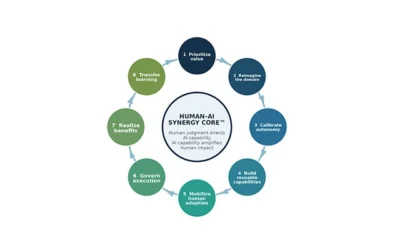
Move Beyond Isolated AI Pilots: Start Transforming Business Domains
How the CMC Domain Transformation Flywheel Turns Human Judgment and AI Capability into Cumulative Business Value The unit of AI transformation should not be the isolated use case. It should be the business domain: an end-to-end system integrating...
The Economics of Agentic AI Where Automation Ends and Autonomy Begins
Where Automation Ends and Autonomy Begins How leaders can determine the economically justified level of autonomy for each business workflow EXECUTIVE SUMMARY The central executive question is no longer whether artificial intelligence can automate work. It...
© 2024 CMC Consulting. All rights reserved.
Matérias Relacionadas
Move Beyond Isolated AI Pilots: Start Transforming Business Domains
How the CMC Domain Transformation Flywheel Turns Human Judgment and AI Capability into Cumulative Business Value The unit of AI transformation should not be the isolated use case. It should be the business domain: an end-to-end system integrating...
The Economics of Agentic AI Where Automation Ends and Autonomy Begins
Where Automation Ends and Autonomy Begins How leaders can determine the economically justified level of autonomy for each business workflow EXECUTIVE SUMMARY The central executive question is no longer whether artificial intelligence can automate work. It...

Before You Decide What to Transform, Ask a Different Question
Organizations rarely suffer from a shortage of transformation initiatives. But each can lead leadership teams to begin the conversation one question too late. WHAT MUST THE ORGANIZATION BECOME CAPABLE OF DOING DIFFERENTLY AFTERWARD? Estimated reading time:...
