

The CIO at an Inflection Point

From Technology Ownership to Enterprise Orchestration
A Framework for CIOs, CEOs and Enterprise Transformation Leaders
By: Carlos Matias – CEO CMC Consulting
Estimated reading time: 8 minutes
The CIO Mandate Is Being Rewritten
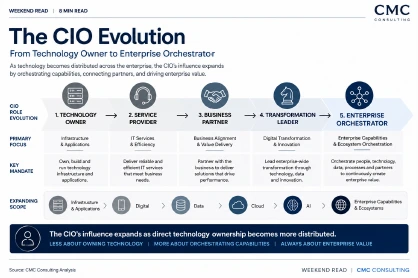
For decades, the CIO mandate was relatively clear: own and run the company’s technology environment, keep systems reliable, protect enterprise data, manage technology investments, deliver major implementations and control IT costs. That mandate expanded through cloud, digital transformation, cybersecurity, data, automation and, more recently, artificial intelligence. But AI is accelerating a more fundamental transition. Technology is no longer confined to the IT organization. Digital capabilities are increasingly embedded across functions, processes, products, customer experiences and business models. Business teams can acquire cloud applications directly. Functions are deploying automation. Employees have access to generative AI. Data is distributed across platforms and ecosystems. As a result, the traditional model of centralized technology ownership is becoming increasingly difficult to sustaint. In plain business terms, the CIO is moving from primarily owning and running technology to connecting technology, data, AI, business functions and partners around enterprise outcomes – from Technology Owner to Enterprise Orchestrator.
1 | Technology Is Becoming Distributed. Accountability Cannot Be.
The democratization of technology creates an apparent paradox. More people across the organization can now select, configure and deploy technology, yet the enterprise still needs architectural coherence, cybersecurity, data governance, interoperability, investment discipline and accountability for business outcomes. Trying to return every technology decision to centralized IT sacrifices speed. Complete decentralization can produce fragmented architectures, duplicated investments, uncontrolled AI experimentation, inconsistent data and growing complexity and cost. The answer is neither centralization nor decentralization. It is orchestration – coordinating distributed capabilities around common standards and outcomes.
2 | AI Is Accelerating the Shift
AI adoption frequently begins outside traditional IT structures: Marketing experiments with content generation, Finance explores forecasting copilots, Supply Chain applies AI to planning and exception management, Operations deploys predictive models, and Customer Service implements intelligent assistants. Without orchestration, organizations risk disconnected pilots, duplicated investment, inconsistent data foundations, unclear decision rights, security exposure and impressive demonstrations that never translate into measurable enterprise value. The CIO can become a central orchestrator of enterprise AI transformation – not by owning every initiative, but by creating the architecture, platforms, governance and standards that allow innovation to scale responsibly.
3 | The Operating Model Must Change
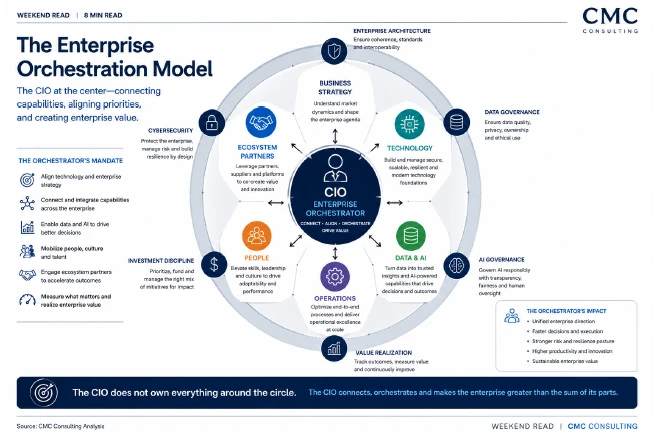
A distributed technology environment cannot be governed effectively through an operating model designed for centralized ownership. The traditional model often positioned IT as a service provider: business functions defined requirements, IT delivered solutions, and systems moved into operations. The emerging model is increasingly collaborative. Business, Technology, Data, Finance, Operations, Security and external partners jointly participate in creating technology-enabled capabilities. The CIO therefore evolves from technology owner and service provider toward business transformation partner, capability architect, portfolio optimizer, ecosystem orchestrator and leader of measurable value creation. Reliability, cybersecurity, architecture, infrastructure and cost management remain essential – but increasingly become foundational capabilities rather than the boundaries of the CIO mandate.
4 | Governance Must Move From Control to Guardrails
Traditional IT governance frequently relied on centralized approval. That becomes difficult when hundreds of technology and AI decisions occur across the enterprise. The alternative is not less governance; it is different governance. Governance guardrails are clear standards and boundaries that let teams innovate without losing enterprise control. Centralize architecture, cybersecurity, identity, critical platforms, data principles, AI governance and major investment policies. Federate – share decision-making with business functions – for applications, automation, analytics and AI use cases operating within enterprise standards. Decentralize local experimentation where risks are limited and the guardrails are respected.
CMC CONSULTING | Executive Perspectives on AI, Technology & Business Transformation
5 | RACI Must Evolve with the Operating Model
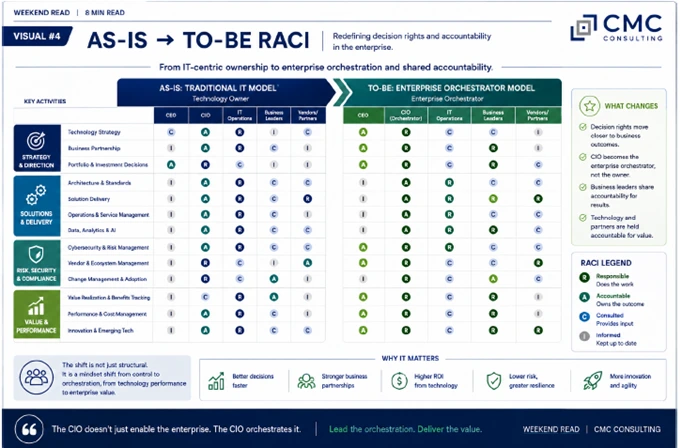
RACI – Responsible, Accountable, Consulted and Informed – is a simple way to clarify who does the work, who owns the decision, and who must be involved. In the traditional model, IT was often both Responsible and Accountable for technology delivery while business functions were mainly Consulted or Informed. That becomes inadequate when technology and business capabilities are inseparable. The emerging model requires shared accountability: business leaders own business outcomes; Technology owns architecture, platforms, integration, security and enablement; Data governs foundations; Finance validates measurable business value; Risk and Security establish guardrails; and partners contribute specialized capabilities. The CIO coordinates the system connecting them. The RACI therefore evolves from a technology delivery model toward an enterprise value-creation model.
6 | The CIO Becomes an Ecosystem Orchestrator
Enterprise technology ecosystems now include major cloud providers, SaaS platforms, AI model providers, implementation partners, startups, universities, specialist vendors and increasingly autonomous AI agents. No organization can internally own every capability required for continuous innovation.
7 | The Ultimate Metric Must Become Value Realization
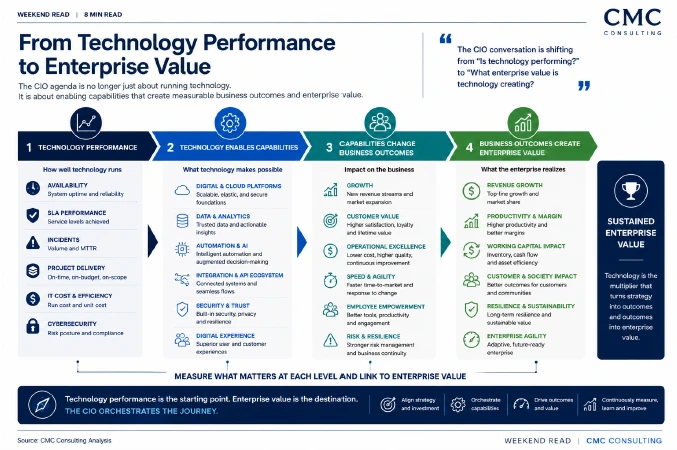
Technology organizations have traditionally tracked availability, project delivery, incident resolution, cybersecurity, technology costs and service levels. These metrics remain important, but boards and CEOs increasingly expect another conversation: What business value is technology creating? Value realization simply means turning technology investment into measurable business results. The scorecard must connect technology to revenue growth, productivity, working capital, customer outcomes, resilience and speed. Technology leadership increasingly needs to demonstrate how platforms and capabilities change operating performance and ultimately create enterprise value. Technology performance is the starting point. Enterprise value is the destination.
8 | Three Actions CIOs Can Take Now
- Map technology decision rights. Identify where technology decisions are actually being made – not where the organization chart suggests they are made. Clarify what should remain centralized, what should be shared with business functions and what can safely be decentralized.
- Redesign governance around guardrails. Replace unnecessary approval layers with clear enterprise standards covering architecture, data, cybersecurity, AI, interoperability and investment discipline. Enable business teams to move faster inside clearly defined boundaries.
- Reframe the technology portfolio around business value. For every significant technology or AI investment, ask: What business outcome are we trying to change? How will we measure it? Who owns the outcome? When should value become visible?
The Leadership Question Ahead
The implications of this leadership transition extend well beyond the technology function.
Capabilities are becoming distributed. Data is becoming distributed. Innovation is becoming distributed. AI is becoming distributed.
Leadership therefore increasingly depends on the ability to connect those distributed capabilities around a common architecture, governance model and set of enterprise outcomes.
The successful CIO of the next decade may consequently own less technology directly while exercising greater influence across the enterprise.
That is the paradox – and the opportunity. How do we connect and orchestrate technology, data, people, processes, partners and AI to continuously create enterprise value?
The organizations that answer that question first may not simply build better technology functions.
They may build more dynamic enterprises.
Executive Perspectives on AI, Technology & Business Transformation
Carlos Matias | CEO, CMC Consulting
- This publication represents the author’s own perspectives and analysis.
- Executive framework and visuals: CMC Consulting Analysis
Looking for something?
Sign up and receive exclusive content.
Categories
Entry and Business Expansion in Brazil
Business Management
Process Management
Interim Management
Follow us on social media
Recent articles
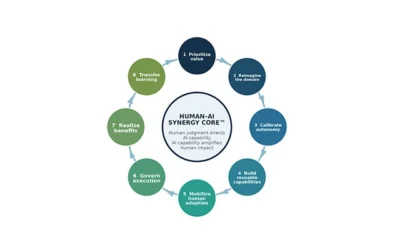
Move Beyond Isolated AI Pilots: Start Transforming Business Domains
How the CMC Domain Transformation Flywheel Turns Human Judgment and AI Capability into Cumulative Business Value The unit of AI transformation should not be the isolated use case. It should be the business domain: an end-to-end system integrating...
The Economics of Agentic AI Where Automation Ends and Autonomy Begins
Where Automation Ends and Autonomy Begins How leaders can determine the economically justified level of autonomy for each business workflow EXECUTIVE SUMMARY The central executive question is no longer whether artificial intelligence can automate work. It...
© 2024 CMC Consulting. All rights reserved.
Matérias Relacionadas
Move Beyond Isolated AI Pilots: Start Transforming Business Domains
How the CMC Domain Transformation Flywheel Turns Human Judgment and AI Capability into Cumulative Business Value The unit of AI transformation should not be the isolated use case. It should be the business domain: an end-to-end system integrating...
The Economics of Agentic AI Where Automation Ends and Autonomy Begins
Where Automation Ends and Autonomy Begins How leaders can determine the economically justified level of autonomy for each business workflow EXECUTIVE SUMMARY The central executive question is no longer whether artificial intelligence can automate work. It...

Before You Decide What to Transform, Ask a Different Question
Organizations rarely suffer from a shortage of transformation initiatives. But each can lead leadership teams to begin the conversation one question too late. WHAT MUST THE ORGANIZATION BECOME CAPABLE OF DOING DIFFERENTLY AFTERWARD? Estimated reading time:...
