

Choosing the right LLM (AI Model) for AI Implementation Strategy
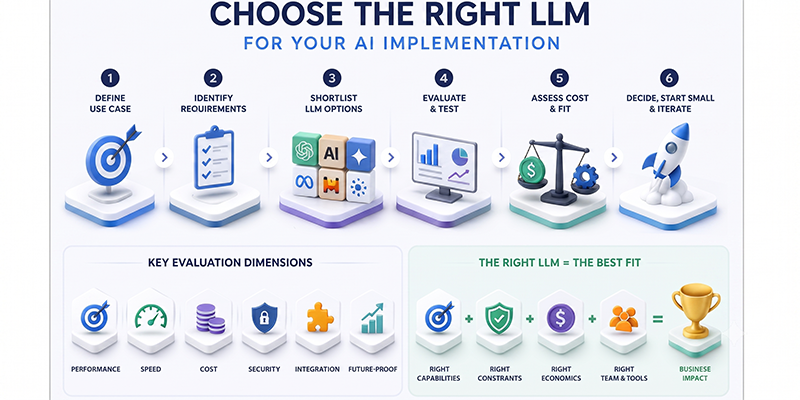
A Framework suitable for Executives and AI Transformation Leaders
By: Carlos Matias – CEO CMC Consulting
Estimated reading time: 10 minutes | July 2026
A Framework Suitable for Executives and AI Transformation Leaders
Executive Summary
Choosing the right Large Language Model (LLM) is one of the most important architectural decisions in an AI implementation program.
The “best” model depends less on benchmark scores and more on the business outcomes, technical constraints, governance requirements, and total cost of ownership.
Many organizations start by asking: “Which is the best LLM?” The better question is: “Which LLM best supports our business strategy?”
Highlights: Different models excel at different capabilities:
- reasoning
- coding
- multilingual support
- cost efficiency
- privacy
- speed
- long-context processing
- multimodal understanding
- enterprise integration
There is rarely one model that is optimal for every workload. Leading organizations increasingly adopt a multi-model strategy instead of committing to a single LLM.
Below is an Execution-oriented Framework suitable for executives and AI Transformation Leaders.
1 – Define the Business Use Cases
Before evaluating models, classify your AI initiatives.
Business Function | Typical AI Use Cases |
Customer Service | Chatbots, ticket summarization |
Sales | Proposal generation, CRM assistant |
Marketing | Content creation |
HR | Recruitment, onboarding |
Procurement | RFQs, contract analysis |
Finance | Reporting, forecasting |
Manufacturing | SOP assistant |
Supply Chain | Planning support, demand analysis |
Legal | Contract review |
Executive | Decision support |
Different use cases require different strengths.
2 – Determine the Required AI Capabilities
Capability Assessment: Consider whether your implementation needs:
- advanced reasoning
- mathematical capability
- coding assistance
- multilingual performance
- translation
- document analysis
- image understanding
- speech capabilities
- planning
- agentic workflows
- retrieval-augmented generation (RAG)
- structured output
- tool use
- function calling
- long context windows
Not every model performs equally across these dimensions.
3 – Identify Enterprise Constraints
Assess the following core enterprise constraint pillars:
- Security: Private cloud, On-premises deployment, Public cloud, Air-gapped environment.
- Compliance: Examples include GDPR, LGPD (Brazil), HIPAA, ISO 27001, SOC 2.
- Data Control: Can data leave the country? Must data remain in a specific cloud region? Can prompts be retained by the provider?
- Governance: Evaluate auditability, traceability, explainability, human approval workflows, and version control.
4 – Evaluate Model Performance
Typical evaluation criteria include:
Criterion | Importance |
Reasoning | Very High |
Hallucination rate | Very High |
Accuracy | Very High |
Reliability | Very High |
Response consistency | High |
Speed | High |
Latency | Medium |
Long context | High |
Tool calling | High |
Function calling | High |
Multimodal | Medium |
Code generation | Depends |
Language quality | High |
5 – Consider Total Cost of Ownership (TCO)
Many organizations focus only on token pricing, but the real TCO also includes:
- API costs
- infrastructure
- orchestration platforms
- vector databases
- embeddings
- monitoring
- observability
- prompt engineering
- evaluation
- security
- maintenance
- model updates
- governance
- AI operations (LLMOps)
For large deployments, these other costs can exceed the model API costs.
6 – Compare Major LLM Providers
Provider | Strengths | Best For | Considerations |
OpenAI | Strong reasoning, coding, enterprise ecosystem | General enterprise AI, agents | API costs, cloud-based by default |
Anthropic | Safety, long-context reasoning | Knowledge work, document analysis | Fewer multimodal capabilities than some competitors (depending on model generation) |
Multimodal, ecosystem integration | Workspace, search, media | Best fit if already invested in Google Cloud | |
Meta (Llama) | Open-weight models | Private deployment, customization | Requires self-hosting or managed infrastructure |
Mistral AI | Efficient open models | European deployments, cost-sensitive workloads | Smaller ecosystem than larger providers |
Alibaba (Qwen) | Strong multilingual capabilities | Asia-focused deployments | Regional ecosystem considerations |
xAI | Strong reasoning focus | Certain research and coding tasks | Enterprise ecosystem is still maturing |
7 – Open versus Closed Models
Closed Models
Advantages: higher performance, managed infrastructure, rapid updates, enterprise support, simpler deployment.
Challenges: vendor dependence, API costs, less control.
Open Models
Advantages: full control, customization, on-premises deployment, lower variable inference costs at scale, privacy.
Challenges: infrastructure management, tuning, operations, model maintenance, engineering expertise.
8 – Multi-Model Strategy
A mature AI architecture often routes requests to different models based on task:
Workload | Recommended Model Characteristics |
Customer chatbot | Fast, lower-cost model |
Coding assistant | Strong code generation |
Executive reports | High reasoning capability |
Legal contracts | High accuracy and long context |
Marketing | Creative language generation |
Document search | Strong RAG integration |
Image analysis | Multimodal capabilities |
This approach balances performance and cost.
9 – Evaluate Enterprise Integration
The chosen model should integrate with fundamental enterprise systems:
- Microsoft 365
- Google Workspace
- Salesforce
- SAP
- Oracle
- ServiceNow
- Slack
- Microsoft Teams
- SharePoint
- CRM platforms
- ERP systems
- Data warehouses
- Business intelligence tools
Integration capabilities can significantly affect implementation effort.
10 – Assess AI Governance
Key governance questions include:
- How is prompt data handled?
- Is customer data used for model training?
- What logging and audit features are available?
- How are access controls managed?
- What monitoring tools exist?
- How are model updates communicated?
- What service-level agreements (SLAs) are offered?
11 – Build a Weighted Decision Matrix
A practical evaluation matrix might include:
Evaluation Area | Weight |
Business Fit | 20% |
Accuracy | 15% |
Reasoning | 15% |
Cost | 10% |
Security | 10% |
Compliance | 10% |
Integration | 10% |
Scalability | 5% |
Latency | 3% |
Vendor roadmap | 2% |
Score each shortlisted model against these weighted criteria to produce a transparent, structured and business-aligned selection.
Conclusions and Recommendations
Typical Enterprise Recommendations by Scenario
Scenario | Suggested Approach |
General enterprise assistant | High-performing commercial model with enterprise controls |
Highly regulated Industry | Private deployment or managed environment with strict governance |
Software development | Model optimized for code generation and reasoning |
Customer support at scale | Fast, cost-efficient model with RAG |
Internal knowledge management | Long-context model integrated with enterprise search |
Global Organization | Strong multilingual model with regional compliance options |
AI Agents and workflow automation | Model with robust reasoning, tool use, and structured outputs |
Best Practices
- Start with business outcomes, not Model rankings.
- Pilot with 2–4 leading Models using your own data and tasks.
- Measure accuracy, latency, cost, user satisfaction, and operational metrics.
- Design for portability so you can switch or add models as the market evolves.
- Combine LLMs with retrieval (RAG), enterprise data, and governance rather than relying on the model alone.
Conclusions
For enterprise AI programs, the winning strategy is typically not selecting a single “best” LLM. It is building a flexible AI platform that can use the most appropriate model for each business scenario while maintaining security, governance, and cost efficiency.
This architecture reduces vendor lock-in, adapts to rapid advances in AI, and maximizes long-term business value.
About the Author: Carlos Matias is the Founder and CEO of CMC Consulting. The purpose of CMC Consulting is to enable and implement the expansion of foreign companies in Brazil, and of Brazilian companies in international markets.
Looking for something?
Sign up and receive exclusive content.
Categories
Entry and Business Expansion in Brazil
Business Management
Process Management
Interim Management
Follow us on social media
Recent articles
Move Beyond Isolated AI Pilots: Start Transforming Business Domains
How the CMC Domain Transformation Flywheel Turns Human Judgment and AI Capability into Cumulative Business Value The unit of AI transformation should not be the isolated use case. It should be the business domain: an end-to-end system integrating...

The Economics of Agentic AI Where Automation Ends and Autonomy Begins
Where Automation Ends and Autonomy Begins How leaders can determine the economically justified level of autonomy for each business workflow EXECUTIVE SUMMARY The central executive question is no longer whether artificial intelligence can automate work. It...
© 2024 CMC Consulting. All rights reserved.
Matérias Relacionadas
Move Beyond Isolated AI Pilots: Start Transforming Business Domains
How the CMC Domain Transformation Flywheel Turns Human Judgment and AI Capability into Cumulative Business Value The unit of AI transformation should not be the isolated use case. It should be the business domain: an end-to-end system integrating...
The Economics of Agentic AI Where Automation Ends and Autonomy Begins
Where Automation Ends and Autonomy Begins How leaders can determine the economically justified level of autonomy for each business workflow EXECUTIVE SUMMARY The central executive question is no longer whether artificial intelligence can automate work. It...

Before You Decide What to Transform, Ask a Different Question
Organizations rarely suffer from a shortage of transformation initiatives. But each can lead leadership teams to begin the conversation one question too late. WHAT MUST THE ORGANIZATION BECOME CAPABLE OF DOING DIFFERENTLY AFTERWARD? Estimated reading time:...
