

How AI will transform BPM (Business Process Management)
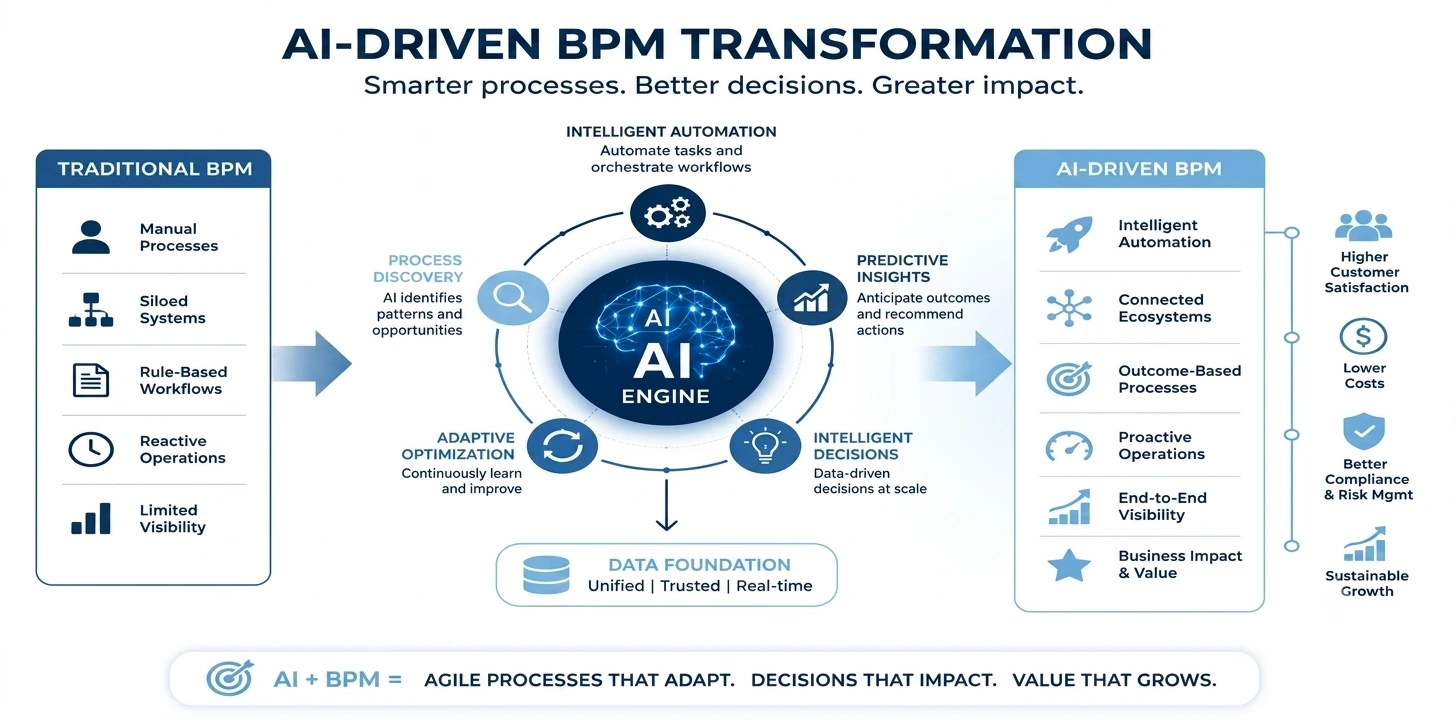
A Practical Roadmap from Legacy BPM Platform to Agentic BPM
By: Carlos Matias – CEO CMC Consulting
Estimated reading time: 12–15 minutes
A Practical Roadmap from Legacy BPM Platform to Agentic BPM
Executive Summary
Artificial Intelligence (AI) is transforming Business Process Management (BPM) from a rigid framework of human-designed rules into a dynamic, self-optimizing intelligence engine.
Instead of just tracking and executing workflows, modern AI-driven BPM systems autonomously analyze patterns, predict bottlenecks, and rewrite processes in real time.
From Static Maps to Instant Generation
Traditional BPM projects often stall during lengthy discovery and interview phases.
AI agents eliminate this administrative burden entirely.
- Instant BPMN Mapping (Business Process Management and Notation): Tools like Prime AI convert text documents, standard operating procedures (SOPs), images, and audio interviews into fully compliant BPMN process maps within seconds.
- Natural Language Orchestration: Business users can describe a desired workflow using natural language, allowing Large Language Models (LLMs) to construct or alter live back-end workflows instantly without requiring technical code.
Shift to AI-Orchestrated & Adaptive Workflows
Traditional BPM relies heavily on strict conditional routing (e.g., “if X, send to Y”).
AI introduces contextual, data-driven execution.
- Contextual Routing: Machine learning models analyze live customer expressions, history, and operational signals to dynamically route tasks to the most optimal department, stepping away from fixed paths.
- Unstructured Data Parsing: Advanced Generative AI functions automatically read, summarize, and extract unstructured documents, such as legal invoices or support tickets, directly handling exceptions that previously required manual intervention.
Predictive Monitoring and Continuous Optimization
AI shifts process management from historical auditing to proactive management.
- Preemptive Bottleneck Detection: Predictive analytics tools track Key Performance Indicators (KPIs) in real time, alerting operations teams to forecasted delays or compliance risks before they actually happen.
- Risk and Fraud Prevention: AI engines continuously screen running transactions for anomalies, stopping non-compliant actions or fraud attempts instantly within the active workflow.
- Simulated Impact Modeling: Organizations can use AI to build digital twin simulation models. This allows teams to test how a process change affects lead times or corporate cash flow without risking live company resources.
The Changing Human Role
As AI scales toward handling roughly 70% of repetitive workflows and preparatory mappings, the operational balance shifts toward the 30% rule for AI.
Human workers transition away from manual data tracking to act as strategic governors, focusing exclusively on complex corporate judgment, creative problem-solving, and managing exception protocols.
Value Generated by Agentic BPM
- Value Generated for Customers (Customer Value)
Drastic Reduction in Waiting Time (Instant Gratification)
The biggest customer bottleneck with legacy BPMs is “operational black holes” — periods where the process sits in a department’s queue waiting for human approval.
- Value: Requests that previously took days (such as opening accounts, approving refunds, analyzing claims or level 1 technical support) can now be resolved in seconds or minutes. Agents clear the mechanical task queue instantly, operating 24/7.
Ultra-Personalized Experience (Context-Aware Execution)
Legacy BPM treats all customers the same way through rigid rules (“If plan = Premium, route A”). Agentic BPM adapts to the individual’s dynamic context.
- Value: Agents analyze the customer’s recent CRM history, the tone of voice or sentiment expressed in the last email, and the current order status to change the priority of service or suggest an automatic compensation offer if a service failure occurs.
Total Transparency and Proactive Communication
Customers hate having to call SAC to ask “What is the status of my process?”.
- Value: As agents monitor the end-to-end flow through the telemetry table, they proactively notify the customer about each micro-evolution of the case (e.g. “We identified an inconsistency in your document, our AI agent has already corrected it based on system data and your process has moved forward”), eliminating customer anxiety and reducing the volume of support tickets.
- Value Generated for Business (Business Value)
Decoupled Headcount Growth (Linear Scalability)
In traditional BPM, doubling the volume of processed tasks (e.g., invoice processing or credit analysis) requires doubling the operational team.
- Value: AI agents scale horizontally—in the cloud or on-premises—within minutes. The company can absorb massive demand spikes without increasing fixed hiring costs, keeping the human team focused solely on handling high-value exceptions [30%].
Problem Resolution Before They Occur (Predictive Proactivity)
Legacy Power BI reports show what went wrong yesterday. Agentic BPM actively uses analytics to predict what will happen tomorrow.
- Value: If an agent identifies that a logistics step is at risk of breaching an SLA due to a supplier delay flagged by BI, it autonomously reroutes the process or engages a backup supplier. This reduces financial losses from contractual penalties and operational downtime.
Continuous Auditing and Zero Compliance Risk
Manual or sampling-based processes often overlook fraud and chronic operational errors that prove costly during annual audits.
- Value: AI agents audit 100% of transactions within the data flow in real-time, verifying regulatory compliance (LGPD, financial rules, governance safeguards). If anomalous behavior is detected, the process is instantly halted before financial closing.
Impact SummaryVALUE MIGRATION:
Legacy BPM ──> Internal Focus ───> How can task costs be reduced?
Agentic BPM ─> Value Focus ─> How can we accelerate the business and delight the Customer?
Main Competitive Advantages Enabled by the Agentic BPM
Migrating from a Legacy BPM platform to Agentic BPM transforms operational efficiency into a strategic market weapon.
While traditional BPM focuses on “reducing the cost of doing the same thing,” Agentic BPM enables the company to do things that competitors stuck in the legacy model simply cannot replicate.
Below are the key competitive advantages enabled by this migration:
- Operational Hyper-speed (The “Instant” Factor): In competitive markets, customers choose the company that responds first. Legacy BPM is constrained by business hours and the speed of human data entry.
- The Advantage: Critical processes (such as credit analysis, new customer onboarding, complex price quoting, or claims processing) shift from taking days to taking seconds.
- Market Impact: The company captures the customer at the exact moment of purchase intent, leaving competitors—who still rely on manual approval workflows and internal emails—behind.
- Frictionless, Asynchronous Scalability: In the traditional model, business growth is constrained by the cost and time associated with hiring and training staff (Headcount Float).
- The Advantage: AI agents instantly handle massive demand spikes, operating 24/7 with horizontal scalability. If the company’s transaction volume surges by 500% in a week, the cost structure remains predictable and stable, as processing capacity automatically adjusts across on-premises servers or hybrid cloud environments [30%].
- Market Impact: The ability to squeeze out smaller competitors during peak seasons or aggressive pricing battles, as the operating margin expands alongside rising volume.
- Strategic Agility Driven by Self-Optimization: Companies with rigid systems take months to modify a business process because they must rewrite code or redesign complex workflows.
- The Advantage: By leveraging an integrated BI loop and orchestration agents, the system adjusts its own routing and capacity allocation rules in real time, based on live market behavior and OKR alerts.
- Market Impact: If economic or regulatory conditions shift in the morning, the operation adapts by the afternoon—while competitors are still scheduling committee meetings to discuss what to do.
- Contextual and Emotional Customer Experience (CX): Traditional BPM is blind to customer nuances; it merely pushes the process along a rigid conveyor belt of coded rules.
- The Advantage: AI agents can interpret sentiment in emails, analyze cross-channel history within the CRM, and instantly cross-reference operational data. The customer ceases to be just a “ticket number” and instead receives a service journey tailored to the urgency of the situation and the value they represent to the business.
- Market Impact: A dramatic increase in Customer Lifetime Value (LTV) and a reduction in churn. Customers develop loyalty because the company resolves issues proactively and seamlessly.
- Unleashing Human Intellectual Capital: The greatest long-term competitive advantage isn’t robots, but what people will do once freed from repetitive tasks.
- The Advantage: By applying the 30% Rule to AI, you take the brightest professionals away from data entry and managing local spreadsheets in Power BI [30%]. They shift to spending 100% of their time on competitive intelligence, product innovation, complex negotiations with major accounts, and governance auditing.
- Market Impact: A company with 100% of its workforce focused on strategy will always beat a company where 70% of the workforce acts as “human middleware,” typing data between screens [30%].
1 | Transition Roadmap from Traditional BPM to AI-driven BPM
A successful transition from traditional Business Process Management (BPM) to an AI-driven BPM requires a phased approach.
Moving directly from rigid, human-designed workflows to fully autonomous AI agents introduces heavy compliance and operational risks.
Here is a structured, 4-stage transformation roadmap designed to safely scale intelligence across the operations.
Phase 1: Foundation & Discovery (Months 1–3)
Objective: Capture reality, identify waste, and prepare data pipelines without altering live workflows.
- Automate Process Discovery: Deploy AI-powered process mining tools (e.g., Celonis, Apromore) to ingest system event logs. This visualizes the actual processes and identifies hidden bottlenecks automatically, bypassing months of stakeholder interviews.
- Assess Data Readiness: Audit the data infrastructure. AI requires structured, clean, and centralized data. Ensure the historical process logs, customer data, and system integration points (APIs) are accessible and securely governed.
- Identify Pilot Candidates: Look for processes that have high volume, low complexity, and high amounts of unstructured data (e.g., invoice processing, customer onboarding, or first-tier support routing).
Phase 2: Assisted Augmentation (Months 4–6)
Objective: Insert AI into existing workflows to assist humans, keeping a strict human-in-the-loop (HITL) model.
- Deploy Generative AI Ingestion: Integrate Large Language Models (LLMs) at the entry points of workflows. Use them to read, summarize, and extract unstructured data from incoming PDFs, emails, or images, converting them into structured data fields for the traditional BPM.
- Implement Instant BPMN Mapping: Use text-to-workflow AI engines to quickly draft and update standard operating procedures (SOPs) and process maps, significantly cutting down administrative overhead for the business analysts.
- Establish Trust Thresholds: Require human oversight for every AI output. For instance, the AI drafts an email response or extracts invoice totals, but a human clerk must click “approve” before the workflow proceeds.
Phase 3: Adaptive Automation (Months 7–12)
Objective: Transition from assistance to autonomous routing and predictive orchestration.
- Shift to Contextual Routing: Replace rigid, hard-coded rule engines (“If X, go to Department Y”) with predictive machine learning models. The AI analyzes historical data, sentiment, and current workloads to dynamically route tasks to the best available resource.
- Activate Predictive Monitoring: Deploy AI monitoring to track live KPIs. The system should alert operations teams to predicted bottlenecks or SLA breaches hours before they actually happen.
- Loosen the Human Tether: For low-risk processes that achieve a 95%+ confidence score from the AI during Phase 2, remove the mandatory human review step. Transition humans to exception handlers who only step in when the AI flags an anomaly.
Phase 4: Autonomous Orchestration (Months 13+)
Objective: Achieve a continuous self-optimizing loop where AI orchestrates the entire ecosystem.
- Deploy Digital Twins & Simulations: Run AI simulation models to test process changes. The AI can simulate thousands of workflow variations to find the most cost-effective path before the deployment of changes to production.
- Enact Agentic BPM: Transition to a network of specialized AI agents that can cross-communicate, negotiate workloads, and self-correct system exceptions without human intervention.
- Re-skill the Workforce: Enforce the “30% rule for AI.” Shift your human team entirely out of transactional data entry and routing. Re-train them to focus on process governance, compliance auditing, strategic growth, and complex edge-case resolutions.
Roadblocks in the Transition – Preventive and Corrective Solutions
Transitioning from a traditional, rules-based BPM to an AI-driven model is rarely a smooth, linear journey. Organizations frequently hit invisible walls related to data quality, culture, and architecture.
Here are the four most common roadblocks along with actionable, concrete solutions to prevent and correct them:
- The “Garbage In, Garbage Out” Data Trap: AI engines require clean, structured, and consistent data to train models and make accurate routing decisions. Traditional BPM processes are often riddled with incomplete logs, manual entry errors, and fragmented data silos.
- Preventive Solution (Do this first): Mandate a strict data hygiene phase during process mining. Use automated data-cleaning scripts to standardize event logs and map missing fields before feeding data into any machine learning models.
- Corrective Solution (Fix it if it’s broken): Build an AI validation layer. If an LLM or predictive engine encounters unstructured data with missing context, program it to automatically flag the file and route it to a human-in-the-loop (HITL) queue for enrichment, rather than letting the flawed process continue.
- “Black Box” Mistrust and Compliance Pushback: Business users, risk officers, and legal teams often resist AI-driven BPM because deep learning models cannot explain why they made a specific decision (e.g., denying a credit application or rerouting a high-value customer).
- Preventive Solution (Do this first): Enforce Explainable AI (XAI). Choose AI models that output confidence scores and key decision drivers (e.g., “Confidence: 94% based on past invoice matches”).
- Corrective Solution (Fix it if it’s broken): Implement a Confidence Threshold Filter. If the AI’s confidence score drops below a specific margin (e.g., 85%), the system must automatically downgrade the automation, pause the transaction, and loop in a human supervisor with an audit trail showing the AI’s reasoning up to that point.
- Employee Resistance and “Shadow BPM”: When employees fear that AI will replace them, they stop feeding the system accurate data, work around the new platform, or create unofficial Excel sheets and manual checkpoints (“shadow BPM”) to regain control.
- Preventive Solution (Do this first): Frame the transition around the 30% Rule for AI. Explicitly market the project internally as an administrative relief initiative. Show employees that AI will eliminate the 70% of mundane data entry they hate, giving them time to focus on high-value governance and exceptions.
- Corrective Solution (Fix it if it’s broken): Establish an Internal AI Champions Network. Identify influential end-users who are struggling with the new system, pull them into feedback loops, and co-design the user interface with them. Turning vocal critics into system trainers rapidly breaks down cultural resistance.
- Architectural Lock-In (The Legacy Monolith): Many legacy BPM suites are highly rigid and cannot easily connect to modern, fast-moving LLM APIs or event-driven AI agents without causing massive system latency or crashing altogether.
- Preventive Solution (Do this first): Build a decoupled, API-first architecture. Instead of trying to inject AI code directly into your core legacy system, use an orchestration middleware layer (like Camunda or an enterprise service bus) to call AI models as external microservices.
- Corrective Solution (Fix it if it’s broken): Deploy wrapper APIs or RPA (Robotic Process Automation) bots as temporary bridges. If your legacy system cannot natively receive structured data from an AI ingestion engine, use a bot to read the AI output and manually type it into the legacy user interface until a permanent API can be built.
Tools to Execute the Transition from Legacy BPM Platform
To successfully transition from a legacy BPM platform to an AI-driven architecture, a specialized set of tools is required. Instead of a single “do-it-all” system, the industry standard is to use a modular, best-of-breed stack.
Here are the recommended tools categorized by their specific role in the transition:
- Process Discovery & Mining (Phase 1): Before changing anything, use these tools to automatically map the current system logs and identify where AI will add the most value.
- Celonis: The market leader in enterprise process mining. It connects to legacy systems (SAP, Oracle, Salesforce), visualizes actual workflows, and uses AI to pinpoint inefficiencies.
- Apromore: An excellent, highly capable open-source alternative. It offers powerful process discovery, predictive analytics, and simulation features without heavy enterprise licensing costs.
- Minit (by Microsoft): If the organization is heavily embedded in the Microsoft ecosystem, Minit (now integrated into Power Automate) provides great process mining capabilities.
- Orchestration & Middleware (The “Digital Spine”): Do not try to force AI logic directly into the rigid legacy code. Use an open, API-first orchestration layer to sit on top of the legacy systems and call AI services.
- Camunda: Highly recommended for this transition. It is an open-source, developer-friendly framework that natively supports BPMN. It acts as a decoupled orchestrator, easily connecting legacy endpoints with modern AI/LLM microservices via APIs.
- Flowable: A lightweight, high-performance BPM engine. Like Camunda, it is highly customizable and allows injecting AI routing logic seamlessly into traditional workflows.
- Appian or Pega: Enterprise low-code platforms that have aggressively integrated AI. They offer built-in generative AI capabilities and predictive routing, though they are more costly and proprietary than open-source engines.
- Data Ingestion & Unstructured Parsing (Phase 2 & 3): Use these tools to convert unstructured data (emails, PDFs, invoices) into clean, structured data fields for workflows.
- UiPath Document Understanding: Combines traditional OCR (Optical Character Recognition) with machine learning to read, interpret, and extract data from complex financial or legal documents.
- Amazon Textract / Google Cloud Document AI: Cloud-native APIs that use machine learning to instantly read forms and tables, perfect for building automated ingestion pipelines that feed the orchestrator.
- LangChain / LlamaIndex: Open-source frameworks used by developers to orchestrate Large Language Models (like OpenAI or Anthropic). They are essential for building custom GenAI agents that summarize or audit workflow documents.
- Integration Bridges (The “Temporary Patch”): If the legacy BPM is so old that it completely lacks APIs, use these to pass data between the AI and the legacy UI.
- Automation Anywhere or UiPath RPA: Use Robotic Process Automation (RPA) strictly as a bridge. Let the AI make the decision, and let the RPA bot type that decision into the legacy software’s user interface until you can decommission the legacy system.
Summary Stack Recommendation:
For a modern, flexible, and scalable setup, the most common architectural combination is:
Celonis (for finding the bottlenecks) → Camunda (to run the overall workflow) → OpenAI / Anthropic APIs via LangChain (to handle the intelligence and data processing).
Key Elements of Data Architecture
To ensure the success of the data architecture during the transition from legacy BPM to Agentic BPM—especifically in a scenario lacking a Lakehouse or modern cloud databases—the focus must shift from “massive storage” to the availability, speed, and contextualization of local structured data.
AI agents cannot make autonomous decisions if the data is fragmented, slow, or lacks clear meaning.
Below are the key elements for structuring the current data architecture for this new era:
- Event-Driven Data Ingestion: AI agents operate in the “now.” They cannot wait for a data load (ETL) that runs only at night to decide whether a process should be rerouted or an OKR alert issued.
- Adoption of CDC (Change Data Capture): Configure lightweight CDC tools (such as Debezium or native SQL Server/Oracle features) to capture changes in the legacy BPM database the millisecond they occur.
- Webhooks and Local Message Queues: Use lightweight, locally installed message brokers (such as RabbitMQ or a simple Redis infrastructure) to queue process actions and distribute them to AI agents, avoiding bottlenecks in the main database.
- Centralized Semantic Layer (Data Cataloging for AI): One of the biggest mistakes during the transition is granting AI direct access to raw, coded tables from the legacy system (e.g., tables with names like TB_PROC_01_FIN). The AI will fail when attempting to interpret this data.
- Business-Oriented Data Dictionary: Create SQL Views or a robust semantic layer in the BI Application where fields are translated from technical codes into clear business terms (e.g., Payment_Status, Approval_Date).
- Rich Metadata: Document the meaning of each column in text format. When the AI agent queries the database or reads the data model, it will use this metadata to understand the process context before making a decision.
- Read Replicas and Workload Isolation: Analytical and predictive AI agents will execute constant, complex queries to project OKR outcomes and detect anomalies. If these queries run against your legacy BPM’s production database, the operational system will crash.
- Local Read Replicas: Configure database mirroring or continuous replication (e.g., SQL Server Always On).
- Workload Separation: The legacy BPM continues to operate on the primary database. AI agents and Power BI DirectQuery reports query only the replicated database, eliminating the risk of operational downtime.
- Unified Telemetry Table and AI Logs (Audit Trail): For Power BI to display the Agentic BPM dynamic scorecard, the data architecture must provide a rigid structure to record the behavior of the intelligence itself.
- Agent Log Schema: Create a central table (ex: Log_Agentes_BPM) that records:
- Process_ID / Transaction_ID
- Agent_Name (e.g., Triage_Agent)
- Decision_Taking (Payload in text or JSON)
- Confidence_Score (0 to 100)
- Estimated_Cost_Tokens (For CFO financial control)
- Intervention_Status (Whether it was autonomous or underwent human approval – HITL)
- Agent Log Schema: Create a central table (ex: Log_Agentes_BPM) that records:
- Hybrid Strategy for Unstructured Data Ingestion: Approximately 70% of bottlenecks in legacy BPM systems involve unstructured data (invoice PDFs, customer emails, contract images). The data architecture must be capable of handling this data temporarily before sending the cleaned data to the relational database.
- Organized File Servers: Structure local file repositories (NAS/SAN) using standardized, secure network paths (UNC paths) so that AI extraction agents (OCR/LLMs via local scripts) can access, read, and process the data, and then insert the structured results back into the traditional SQL database.
2 | Main Migrations to Agentic BPM
2.1 | OKR Scorecard (KPI’s)
Migrating the OKR (Objectives and Key Results) Scorecard from a legacy, manually updated platform to an Agentic BPM ecosystem transforms OKRs from a static, reactive tracking sheet into a live, self-correcting execution engine.
Instead of humans manually updating spreadsheets at the end of the quarter, autonomous AI agents continuously monitor workflows, predict key result outcomes, and dynamically reallocate resources.
The Architecture Shift: Legacy vs. Agentic OKRs
Feature | Legacy OKR Scorecard | Agentic BPM OKR Engine |
Data Updates | Manual entry (monthly/quarterly) | Real-time via automated data streams |
Progress Tracking | Historical ("What happened?") | Predictive ("What will happen next month?") |
Resource Allocation | Fixed annual/quarterly budgets | Dynamic, agent-negotiated shifting |
Risk Management | Escalation after a Key Result is missed | Preemptive intervention before the breach |
Step-by-Step Migration Roadmap:
- Decouple and Digitize the Key Results (The Ingestion Layer): Dissect your current OKRs. If a KR says “Improve customer onboarding speed by 20%,” find the system event logs (e.g., in Camunda or Salesforce) that track the timestamp from user registration to first value. Connect these endpoints using an orchestration layer (like Camunda or Flowable) or enterprise integration hubs.
- Deploy specialized “Observer Agents” (The Analysis Layer): Replace manual review meetings with autonomous Observer Agents running time-series forecasting (e.g., warning that KR 2.1 will fail in 14 days) and context summarization using tools like LangChain.
- Implement “Orchestrator Agents” for Self-Correction (The Action Layer): When a Key Result is flagged as “at risk”, an Orchestrator Agent takes autonomous action, such as dynamically reallocating operational capacity or requesting temporary API capacity/resources.
- Establish the “Human-in-the-Loop” Governance Layer: Humans set the ultimate “Objectives” and handle exceptions through confidence triggers when massive process changes are required.
2.2 | Management Dashboard
In the new Agentic BPM era, scorecards and dashboards shift from static, retrospective grave markers into live, predictive control centers operated by autonomous AI agents.
Key Architectural Shifts
Feature | Legacy BPM Dashboard | Agentic BPM Control Center |
Data Nature | Aggregated, historical batch data | Real-time, continuous event streams |
Primary Visuals | Static bar charts and pie graphs | Live agent graph networks and confidence gauges |
Insights | Descriptive ("We missed our SLA yesterday") | Prescriptive ("SLA breach predicted in 2 hours; fixing now") |
Interaction | Click, filter, and manually drill down | Conversational UI and autonomous action logs |
Core Components of an Agentic BPM Dashboard:
- Predictive Health & Confidence Gauges: Features predictive KPI tracking like confidence trajectory and AI confidence filters.
- The “Agent Network” Topology Map: Displays a live visual graph of interacting AI agents (Ingestion, Audit, Escalation) and real-time token/cost tracking.
- Autonomous Action & Intervention Logs: An immutable audit trail showing self-correction feeds and centralized HITL queues.
- Conversational Query Interface: Natural language prompt boxes allowing executives to query data on the fly (e.g., “Show me why the European supply chain slowed down this morning…”).
2.3 | Integration BI and BPM
The integration of Business Intelligence (BI) tools with Agentic BPM completely redefines the role of BI within companies. In Agentic BPM, BI becomes active and operational (AI consumes real-time metrics to make actionable decisions and autonomously modify processes).
- The Integration Flow (Passive vs. Agentic): Continuous closed loop where BPM sends live telemetry to the BI infrastructure, analytical AI agents monitor tables 24/7, and direct execution triggers BPM APIs to correct operations at the source.
- Changes in BI Processes: End of batch processing (nightly loads) replaced by real-time data streaming, storage in unified Lakehouses (Delta Lake / OneLake), and computational cost metrics tracking LLM tokens.
- How BI Tools Are Adapting: Transitioning into governance interfaces featuring agent graph visualization, bidirectional action (write-back), and ephemeral dashboards via GenAI.
- The New Role of the BI Professional: Shifting to semantic curation and acting as quality guardians of the data feeds.
2.4 | Data Architecture (On-Premises / Legacy Scenario)
Scenario: Legacy does not use Lakehouse or modern Cloud Database (very common with on-premise SQL Server, Oracle, PostgreSQL, or MySQL).
- How to Capture Legacy Data Without the Cloud: Configure CDC (Change Data Capture), database triggers, or webhooks in the legacy BPM to broadcast information the millisecond a row is inserted or updated.
- Integration Architecture with the Current BI Application: Use Power BI Gateway (On-Premises) with DirectQuery mode combined with local AI scripts (Python/Node.js) or lightweight iPaaS tools (n8n, Power Automate Desktop) running at the edge.
- Power BI Dashboard in Practice: Utilize a local SQL audit table (`Log_Agentes_BPM`) read via DirectQuery and embed Power Automate visuals for write-back actions.
- Risks and Prevention: Mitigate potential production database performance bottlenecks by setting up a local Read Replica or mirror database.
2.5 | Workforce
Migrating the workforce from a legacy BPM platform to an Agentic BPM requires a fundamental shift in how human capital is viewed, decoupling headcount volume from business scale [30%].
The Capacity Architecture Shift:
- Legacy BPM Workforce: [70% Manual Execution & Data Entry] → [20% Exception Handling] → [10% Strategy]
- Agentic BPM Workforce: [10% Agent oversight] → [40% Complex exception handling] → [50% Strategy & Governance]
Step-by-Step Workforce Migration Strategy:
- Audit and Categorize Headcount: Categorize tasks into Repetitive, Heuristic, and Creative/Strategic to identify the “Transactional Headcount Float.”
- Re-Architect Job Roles: Transition staff into Process/Agent Governors, Exception Specialists, and Knowledge Engineers.
- Transition Training (Shadowing to Supervising): Move employees through Shadowing, Supervising (HITL), and Governing phases to build trust.
- Optimize Headcount via Strategic Attrition: Break the volume-to-headcount link, allowing transaction volume to surge while headcount remains flat and reinvesting savings into high-value engineering and growth roles.
3 | Executive Management
3.1 | ROI Calculation
To estimate the Return on Investment (ROI) of migrating to Agentic BPM, weigh the reduction in operational costs and revenue gains driven by speed against the actual implementation cost.
- Mapping Financial Gains: Reductions in processing cost per transaction (automating ~70% of mechanical tasks) [30%], elimination of error/fines/rework costs (~80% reduction), and revenue gains from service speed (Time-to-Value, projecting 10-15% conversion increases).
- Mapping Investments & Expenses: Software/local infrastructure, development/consulting hours, and API token consumption costs ($0.02 to $0.05 per processed transaction).
- Practical Example: A 10,000 transaction/month operation generating $480,000 in first-year savings with a $120,000 setup investment yields a **300% ROI** with a **3-month payback period**.
3.2 | Risks Assessment and Mitigation
Given the local infrastructure scenario, the five key risks and mitigations include:
- Production Database Performance Degradation: Mitigate by implementing a local Read Replica (SQL Server Always On) for BI and AI queries.
- Operational “Hallucination”: Mitigate using a Confidence Threshold Architecture (auto-halting processes and routing to HITL if confidence falls below 85-90%).
- Exposure and Leakage of Sensitive Data: Mitigate using corporate contracts with Zero Data Retention (ZDR) or running local open-source models (Llama 3, Mistral).
- Cultural Resistance and Employee Boycott: Mitigate by enforcing the “30% Rule for AI” and repositioning staff as Agent Governors.
- Fragmentation and Failure of APIs: Mitigate by building a Failover Mechanism (reverting to static rules if API fails) and visual alerts on the dashboard.
FMEA Matrix (Failure Mode and Effects Analysis):
(Refer to the embedded image tracking severity, occurrence, and detection for infrastructure and operational risks:
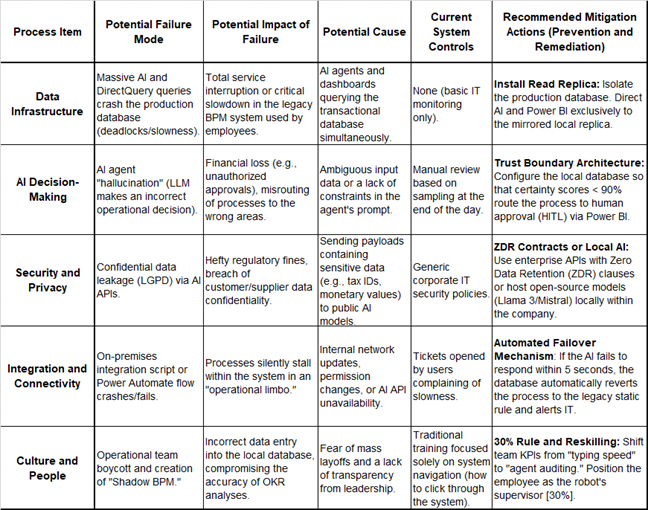 )
)
3.3 | Governance Transition
Managing the transition from traditional governance (human committees, rigid DoA matrices) to agentic governance requires a Progressive Hybrid Governance strategy:
- Step A (Shadow Phase): Code rules as outer guardrails; run the AI in background mode for 60 days to compare decisions against human policy without regulatory risk.
- Step B (Governance by Exception): Switch to Risk-Based and Trust-Based Governance using dynamic risk matrices (Impact Value + Agent Certainty).
- Step C (Chain of Thought Logging): Transform “black boxes” into transparent audit trails by saving prompts, local data context, and LLM responses in the `Log_Agentes_BPM` table.
- Step D (Establish AI Process COE): Shift the BPMO from auditing flowcharts to monitoring agent performance metrics.
(Governance Model Shift: 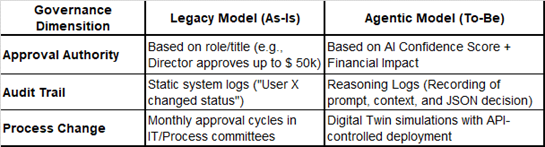 )
)
Handling Structured External Audits (SOX, ISO) & Executive Rules: Enforce Digital Segregation of Duties (SoD) for API tokens, use the reasoning log as unalterable audit proof, block delete/update permissions on log tables, and embed the Delegation of Authority (DoA) matrix directly into the local orchestrator.
3.4 | Executive Support
For a successful transition, executive leadership must provide active, strategic governance:
- CEO: Establish cultural cover via the 30% Rule for AI and redefine operational KPIs around velocity and outcomes.
- CFO: Fund by phase (matching the 4-stage roadmap) and structure financial models for OpEx token consumption.
- CIO / CTO: Enforce decoupled, API-first architecture and prioritize centralized data spine engineering.
- CLO / CRO: Define confidence thresholds and establish robust AI audit protocols for regulatory compliance.
- CHRO: Overhaul corporate talent playbooks, replacing legacy titles with Agent Governors and Knowledge Engineers.
Conclusions
The integration of Artificial Intelligence (AI) into Business Process Management (BPM) marks a profound shift from static, rule-based automation to dynamic, self-evolving operational ecosystems.
Core pillars of this transformation include:
- From Transactional to Conversational Logic: Natural language interfaces and democratized modeling allow non-technical employees to generate compliant process charts instantly.
- Shift from Cost Savings to Strategic Growth: AI introduces hyper-adaptability, reconfiguring process flows on the fly without manual reprogramming to stimulate top-line and bottom-line growth.
- Reactive Management Becomes Predictive: Real-time anomaly detection and continuous self-optimization shift risk management into a preventative framework.
- The Augmented Workforce (The 70/30 Rule): AI automates the mechanical ~70% of execution while human workers retain the critical 30% centered on contextual judgment, complex problem-solving, and ethical oversight.
Ultimately, the combination of AI and BPM has evolved into an unavoidable corporate necessity. Organizations that embrace these automated, self-correcting workflows gain immense competitive leverage, converting day-to-day operations into a sustainable engine of continuous innovation.About the Author: Carlos Matias is the Founder and CEO of CMC Consulting. The purpose of CMC Consulting is to enable and implement the expansion of foreign companies in Brazil, and of Brazilian companies in international markets.
Looking for something?
Sign up and receive exclusive content.
Categories
Entry and Business Expansion in Brazil
Business Management
Process Management
Interim Management
Follow us on social media
Recent articles
Move Beyond Isolated AI Pilots: Start Transforming Business Domains
How the CMC Domain Transformation Flywheel Turns Human Judgment and AI Capability into Cumulative Business Value The unit of AI transformation should not be the isolated use case. It should be the business domain: an end-to-end system integrating...
The Economics of Agentic AI Where Automation Ends and Autonomy Begins
Where Automation Ends and Autonomy Begins How leaders can determine the economically justified level of autonomy for each business workflow EXECUTIVE SUMMARY The central executive question is no longer whether artificial intelligence can automate work. It...
© 2024 CMC Consulting. All rights reserved.
Matérias Relacionadas
Move Beyond Isolated AI Pilots: Start Transforming Business Domains
How the CMC Domain Transformation Flywheel Turns Human Judgment and AI Capability into Cumulative Business Value The unit of AI transformation should not be the isolated use case. It should be the business domain: an end-to-end system integrating...
The Economics of Agentic AI Where Automation Ends and Autonomy Begins
Where Automation Ends and Autonomy Begins How leaders can determine the economically justified level of autonomy for each business workflow EXECUTIVE SUMMARY The central executive question is no longer whether artificial intelligence can automate work. It...

Before You Decide What to Transform, Ask a Different Question
Organizations rarely suffer from a shortage of transformation initiatives. But each can lead leadership teams to begin the conversation one question too late. WHAT MUST THE ORGANIZATION BECOME CAPABLE OF DOING DIFFERENTLY AFTERWARD? Estimated reading time:...
