

GenAI is not replacing interim leaders. It’s amplifying their impact.

Estimated reading time: 8–10 minutesSource: interimmanagementworldwide
What we’re seeing across transitions, integrations and turnarounds is a clear shift: AI-enabled interim mandates deliver faster insight, stronger governance and measurable financial uplift within the lifespan of the assignment.
Generative AI (GenAI) is reshaping leadership in transition. Interim managers – called in during periods of change, growth, or crisis – are under constant pressure to deliver fast, measurable results.
GenAI has emerged as a powerful lever, augmenting decision-making, accelerating project delivery, and strengthening investor confidence through more reliable forecasting and reporting. 70% of organizations already use GenAI in at least one business function, with adoption projected to reach nearly 90% by 2027.
Yet Gartner predicts that 30% of GenAI projects will be abandoned within the same timeframe, highlighting the need for disciplined governance and realistic expectations.
For interim managers, this duality – potential vs. risk – is particularly acute, since assignments are short, outcomes highly visible, and investors impatient for ROI.
Challenges
Interim management exists to fill leadership gaps and execute transformations under time pressure. The value proposition is speed, neutrality, and execution discipline. Yet interim leaders face recurring challenges:
- Information overload: Reports are fragmented, data quality inconsistent, and decision cycles slow.
- Stakeholder pressure: Boards and investors expect immediate visibility of progress.
- Short horizons: Interim assignments rarely exceed 6–12 months, leaving little room for trial and error.
GenAI promises to ease these constraints by automating reporting, simulating scenarios, and enhancing analysis. However, many organizations have not scaled GenAI beyond pilots. About 30% of companies report scaled GenAI use in operations, while 63% remain exploratory.
Interim managers, therefore, step into environments where expectations are high but AI maturity is still low – creating both opportunity and risk.
Executive Insight:
For boards and investors, the problem is clear: traditional interim management is effective, but speed is limited by human bandwidth.
GenAI offers acceleration, but only if adoption barriers – data quality, scaling, governance – are addressed.
Decision-Making & Strategy
One of the most immediate applications of GenAI in interim management is decision support. Interim executives are often hired to stabilize a situation and set a new course within weeks, not months.
GenAI tools can: Generate scenario analyses faster, allowing boards to weigh trade-offs. Produce forecasting models that integrate market and internal data. Automate board meeting preparation, synthesizing data into coherent packs.
Executive Insight:
GenAI accelerates interim managers’ ability to produce forecasts and scenarios, a core demand from boards.
Investors should see GenAI not as a replacement for judgment but as a force multiplier in high-stakes decision-making.
Mission Delivery
Interim Managers are often tasked with delivering transformation projects – ERP rollouts, restructuring programs, M&A integrations – under strict timelines.
GenAI has three visible impacts here:
- Project Planning: AI-generated Gantt charts, workstreams, and risk registers shorten planning cycles.
- Communication: Interim leaders should use GenAI to draft project updates, status reports, and stakeholder communications at scale.
- Documentation: Compliance-heavy sectors (pharma, finance, legal, etc.) benefit from AI-generated documentation and summaries.
Executive Insight:
Faster project delivery translates directly into ROI. For investors, the equation is clear: GenAI reduces overhead in reporting and documentation, freeing interim leaders to focus on stakeholder management and execution.
Cost & ROI Impact
The strongest argument for GenAI in interim management is financial. The ROI equation typically comes from three levers:
- Labor savings: Automating routine reporting and analysis.
- Faster delivery: Compressing timelines for integration or transformation projects.
- Better decisions: Improving EBIT impact through more accurate forecasts.
Among the top-performing companies that successfully execute comprehensive AI workflows, targeted metrics show an average EBITDA improvement of 10% to 25%. Interim mandates, with their short horizons, offer an ideal test bed for realizing such benefits quickly.
Executive Insight:
For investors, GenAI makes interim management not just a bridge solution but a value-creation lever.
With ROI multiples of 2–3x, interim mandates enhanced by GenAI can directly impact exit valuations.
Market Dynamics & Competitive Advantage
The interim management market is being reshaped by how quickly organizations adopt GenAI.
The main business driver for AI adoption varies by economic region:
- North America: Adoption is investor-driven. Private equity houses are embedding AI-readiness into due diligence, and interim executives are expected to deliver EBITDA impact in months. U.S. organizations report higher tolerance for pilots and experimental rollouts, prioritizing speed over control.
- Europe: Adoption is more compliance-led. The EU AI Act requires classification of AI systems, risk assessments, and audit trails. Interim managers must balance innovation with regulatory obligations, especially in financial services, healthcare, and manufacturing.
The prize is substantial: only about 20% of companies have successfully scaled one GenAI use case – meaning interim managers who bring AI-fluency position themselves ahead of 80% of the market.
Executive Insight:
In North America, advantage comes from early deployment.
In Europe, from governance credibility.
Both paths reward interim leaders who integrate GenAI into mandates.
Ethical & Governance
Risks become magnified in interim contexts, where leaders inherit fragile trust and short timelines:
- Bias: AI-driven talent vetting risks reinforcing systemic inequalities.
- Privacy: Interim leaders process highly sensitive company data; AI tools increase exposure to leakage.
- Transparency: Boards demand explainability for AI-derived conclusions.
- Regulation: The new regulatory AI Acts arising tend to classify decision-support tools as high-risk, requiring monitoring and documentation.
Best practice is to define an AI protocol from day one: what tasks AI may support, how outputs are validated, and how governance is documented.
Executive Insight:
Governance is not optional. A single AI misstep can undo board trust.
Interim leaders who set clear rules enhance credibility with regulators and investors.
Operational Efficiency
GenAI relieves interim managers from routine burdens:
- Drafting management packs and dashboards.
- Automating compliance reports.
- Cleaning and synthesizing disparate data sources.
But the gains are fragile. Gartner warns that 30% of GenAI projects fail due to weak data pipelines. Interim managers must secure data quality as much as deploy AI tools.
Executive Insights:
GenAI efficiency is real – but only if interim leaders also repair data foundations.
Otherwise, automation simply accelerates bad inputs.
Skill Evolution – Competency Framework
Traditional interim strengths (crisis navigation, finance, transformation) are no longer enough.
Today’s Competencies:
- Crisis management
- Financial control
- Transformation leadership
Tomorrow’s Competencies:
- AI & Data Literacy – understanding GenAI applications and limits.
- AI-augmented Forecasting – scenario modeling, stress testing.
- Digital Governance – compliance with AI regulations.
Predictions suggest that AI-literate leaders will command premium fees; Interim Management Service providers already observe higher day rates for interim managers who integrate AI into assignments.
Executive Insight:
The differentiator is AI literacy – not coding, but knowing how to ask the right questions and validate AI outputs.
Comparison with Traditional Automation
- RPA: Automates repetitive, rules-based processes.
- Analytics tools: Provide dashboards and retrospectives.
- GenAI: Produces narrative insights, forecasts, and board-level scenarios in natural language.
This evolution makes GenAI uniquely suited to interim mandates, where time is short and board impact must be immediate.
Executive Insight:
GenAI shifts interim work from execution to augmentation of board-level strategy.
AI in Corporate Governance
CorpTech and AI-Assisted Boards
CEOs and board members increasingly see AI as a strategic partner in decision-making.
The emerging framework CorpTech encompasses:
- Assisted AI: task execution without decision influence.
- Augmented AI: decision support via analytical insights.
- (Future) Replacement AI: autonomous board participation.
For interim leaders, AI offers objectivity and data depth for validating business plans and capital decisions, but requires new skills in AI literacy and risk control.
Interim Managers must:
- Understand how AI systems derive conclusions (managerially, not technically).
- Manage ethical and operational risks with strong human oversight.
- Establish formal AI-governance policies specifying where and why AI is used.
Executive Insight:
Embedding AI in governance enhances objectivity and transparency but raises accountability questions.
Interim leaders who define AI-governance policies early reinforce board trust and regulatory confidence.
Agentic AI and the Acceleration of Change
Operational Interim Managers view Agentic AI as a goal-driven digital workforce autonomously planning, executing, and optimizing tasks around the clock.
Ideal contexts: data-intensive functions requiring analytics, model creation, and rapid decisions.
As office automation once did, Agentic AI elevates human roles toward oversight and creativity.
Key IM challenges:
- Identify activities best transferred to AI.
- Design new organizations blending human and artificial intelligence.
- Implement re-/up-skilling plans critical for SMEs where workforces are older and long-tenured.
The Near Future: The Emerging Dual Standard
By 2030, AI fluency will define the professional baseline for interim leaders:
- AI-enabled interims command fee premiums of 20–30%, reflecting the growing scarcity of hybrid managerial profiles combining strategic foresight, data literacy, and governance fluency. Interim service providers and associations are expected to introduce formal AI-readiness certifications to validate these skills across global assignments.
- Interims lacking demonstrable GenAI literacy are projected to face up to 40% lower assignment conversion rates, as clients favor candidates with AI-driven case histories.
The regional split will persist:
- North America will prioritize speed and quantifiable ROI.
- Europe will prioritize trust, transparency, and compliance credibility.
Interims who can operate fluently across both paradigms – combining the velocity of execution with the rigor of governance – will define the next generation of leadership in transition.
Executive Insight:
Global signal: Investors must interpret both dimensions – execution velocity and regulatory resilience – to identify sustainable value creation.
By 2030: The “AI-literate interim” becomes the market default; those without GenAI fluency risk structural marginalization.
Conclusion: The Next Era of Interim Leadership
Generative AI (GenAI) is not replacing interim managers – it is multiplying their strategic and financial impact.
What began as an experimental support tool is now a core accelerator of value creation in leadership transitions, integrations, and turnarounds.
AI-enabled interims are already redefining the speed, accuracy, and credibility with which change is delivered.
A Measurable Return for Investors
For investors and boards, the ROI case is no longer speculative.
- Interim mandates enhanced by GenAI deliver ROI multiples of 2–3x versus assignment costs. Reporting automation and scenario modeling save an average of 25–30% of project time. Forecasting accuracy improves by 20–25%, strengthening investor confidence and enabling faster refinancing or M&A readiness.
- McKinsey found that firms using GenAI in decision support attribute 10–15% of EBIT growth directly to AI-assisted analysis and faster execution.
GenAI thus transforms interim management from a “stabilization mechanism” into a value-creation function, capable of producing tangible financial uplift within the lifespan of a mandate.
A Structural Shift for Executives and Boards
For executives, GenAI delivers both speed and strategic coherence. AI-assisted dashboards, predictive models, and automated board reporting shorten feedback loops and compress execution cycles from months to weeks.
At the same time, transparency improves: forecasts, risk models, and board packs generated by GenAI reinforce governance discipline and investor trust.
Boards that once relied on human-only judgment now gain augmented visibility – an analytical lens that enhances but never replaces executive intuition.
The combination of AI precision and human situational judgment is becoming the new standard for high-performance governance.
A New Competency Model for Interim Managers
For interim managers themselves, GenAI demands new skills and mindsets. The most successful interims demonstrate three emerging competencies:
- AI Literacy – Understanding what GenAI can and cannot do, interpreting outputs, and integrating tools into daily workflows.
- Governance Fluency – Applying AI regulation instruments and principles, ISO 42001 frameworks, and ethical oversight to ensure compliant adoption.
- Pilot Leadership – Designing, testing, and scaling GenAI pilots within short-term mandates, linking experiments to measurable business outcomes.
By 2030, interims lacking these competencies risk marginalization. AI-literate interim leaders will command day-rate premiums of 20–30% and will dominate cross-border mandates where data governance and investor expectations intersect.
The Speed–Governance Equation
The most competitive firms will be those capable of mastering both: velocity of execution with integrity of control.
The Strategic Imperative
GenAI has become the new frontier of competitive differentiation in interim management:
- It allows investors to de-risk transitions.
- It enables boards to make faster, data-backed decisions.
- It empowers interim leaders to deliver transformations at unprecedented speed and precision.
The question is no longer if GenAI belongs in interim mandates, but how rapidly firms will embed it as a permanent capability. Interim managers who integrate GenAI responsibly – combining automation, insight, and governance – will lead the future of corporate transformation.
Carlos Matias is the Founder and CEO of CMC Consulting. The purpose of CMC Consulting is to enable and implement the expansion of foreign companies in Brazil, and of Brazilian companies in international markets.
Looking for something?
Sign up and receive exclusive content.
Categories
Entry and Business Expansion in Brazil
Business Management
Process Management
Interim Management
Follow us on social media
Recent articles
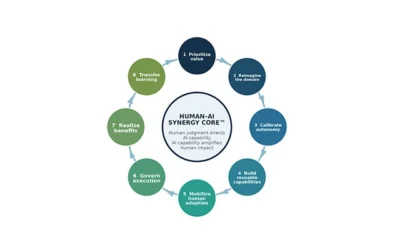
Move Beyond Isolated AI Pilots: Start Transforming Business Domains
How the CMC Domain Transformation Flywheel Turns Human Judgment and AI Capability into Cumulative Business Value The unit of AI transformation should not be the isolated use case. It should be the business domain: an end-to-end system integrating...
The Economics of Agentic AI Where Automation Ends and Autonomy Begins
Where Automation Ends and Autonomy Begins How leaders can determine the economically justified level of autonomy for each business workflow EXECUTIVE SUMMARY The central executive question is no longer whether artificial intelligence can automate work. It...
© 2024 CMC Consulting. All rights reserved.
Matérias Relacionadas
Move Beyond Isolated AI Pilots: Start Transforming Business Domains
How the CMC Domain Transformation Flywheel Turns Human Judgment and AI Capability into Cumulative Business Value The unit of AI transformation should not be the isolated use case. It should be the business domain: an end-to-end system integrating...
The Economics of Agentic AI Where Automation Ends and Autonomy Begins
Where Automation Ends and Autonomy Begins How leaders can determine the economically justified level of autonomy for each business workflow EXECUTIVE SUMMARY The central executive question is no longer whether artificial intelligence can automate work. It...

Before You Decide What to Transform, Ask a Different Question
Organizations rarely suffer from a shortage of transformation initiatives. But each can lead leadership teams to begin the conversation one question too late. WHAT MUST THE ORGANIZATION BECOME CAPABLE OF DOING DIFFERENTLY AFTERWARD? Estimated reading time:...
