

Move Beyond Isolated AI Pilots: Start Transforming Business Domains
How the CMC Domain Transformation Flywheel Turns Human Judgment and AI Capability into Cumulative Business Value
The unit of AI transformation should not be the isolated use case. It should be the business domain: an end-to-end system integrating decisions, workflows, data, technology, roles, controls, and outcomes. When each transformed domain leaves behind reusable capabilities, the next transformation starts with greater momentum.
Field | Publication Summary |
Publication | CMC AI Transformation Series 004 |
Audience | CEOs, boards of directors, transformation leaders, and business domain owners |
Status | English master version |
The Pilot Paradox
AI experimentation is no longer scarce. Companies are accumulating copilots, prototypes, workflow automations, and agentic pilots at a breathtaking pace. However, expanding the portfolio of use cases does not automatically produce transformation. This movement can also generate fragmented data, duplicated platforms, inconsistent controls, unclear responsibilities, and benefits that remain invisible on the income statement.
The problem is not experimentation itself. Experimentation is essential for learning. The problem arises when the experiment becomes the unit of scale. A use case can improve a specific task without altering the surrounding process, decision rights, incentives, handoffs, and the ultimate outcome delivered to the customer.
Therefore, the executive question needs to change. Instead of asking “Where can we apply AI?”, leaders should ask: “Which business domain is important enough to be reimagined? What economic outcome needs to change? And what combination of people, processes, data, technology, and autonomy will produce that result?”
Make the Business Domain the Unit of Transformation
A business domain is an end-to-end value creation space, such as customer service, procurement, supply chain planning, order-to-cash, product development, field services, or claims management. It brings together multiple decisions and workflows that can be redesigned together to achieve a measurable business outcome.
This shift matters because transformation value rarely comes from a single model or agent. It stems from the coordinated redesign of the entire system in which the technology operates. Domain-based management also establishes a responsible business sponsor, a coherent baseline to measure value, and a practical perimeter for governance.
In a WIRED and McKinsey interview published in September 2026, Dan Swan argued that leading companies concentrate their efforts on two or three business domains rather than scattering them across isolated use cases. The interview presents Toyota’s supply chain digital twin and DBS Bank’s progressive expansion across different domains as examples of transformation capabilities that become more reusable over time. These cases reinforce an important conclusion: transformation does not merely consume capabilities. When well-conceived, it also produces new ones.
The CMC Domain Transformation Flywheel™
The CMC Domain Transformation Flywheel™ is a management architecture that converts a sequence of AI initiatives into cumulative business capabilities. It is neither a maturity scale nor a methodology for a single project. Each turn must generate business value while leaving stronger foundations for the next domain.
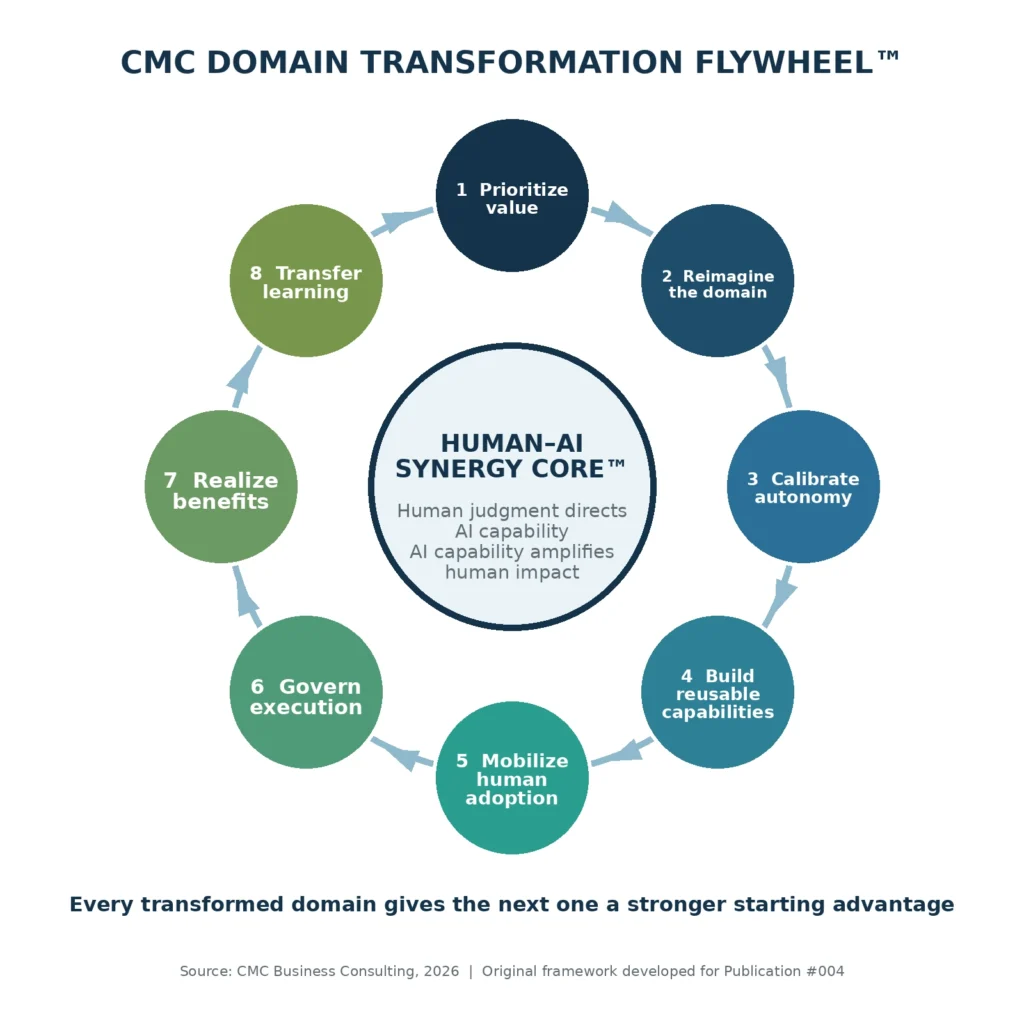 Accessible figure description: Circular flywheel composed of eight movements around a Human–AI Synergy Core: prioritize value, reimagine the domain, calibrate autonomy, build reusable capabilities, mobilize human adoption, govern execution, realize benefits, and transfer learning.
The Human–AI Synergy Core
The Flywheel is driven by two complementary sources of energy. Human energy contributes business judgment, context, creativity, empathy, accountability, ethics, and leadership. AI energy contributes analytical scale, speed, pattern recognition, orchestration, automation, and continuous learning.
Neither source is sufficient on its own. Human judgment without technological amplification cannot operate with today’s available speed and complexity. AI capability without human direction can optimize the wrong objective, amplify fragile data, or accelerate risks.
The guiding principle is simple: human judgment directs AI capability; AI capability amplifies human impact; and joint learning accelerates the next domain. This Human–AI Synergy Core connects the Flywheel directly to CMC’s Human-Centered AI Transformation Framework™.
Eight Movements Generating Cumulative Momentum
1. Prioritize Value
What outcome is important enough to justify the transformation?
Select a small number of domains where you can produce relevant shifts in customer value, strategic differentiation, costs, growth, resilience, or risk. Establish an economic baseline before choosing technology. The goal is not to find the easiest AI use case, but to identify a relevant value source backed by a committed business owner.
2. Reimagine the Domain
How would this system work if it were designed today?
Map end-to-end decisions, activities, handoffs, controls, friction points, and customer journey moments. Question legacy assumptions from the current process. Applying automation to a poorly designed process may only make waste circulate faster. Reimagining the domain allows you to decide what should disappear, what should be simplified, and what needs to be created.
3. Calibrate Autonomy
What decisions can AI recommend, execute, or govern within defined boundaries?
Choose the appropriate level of autonomy for each task and decision. Consider economic potential, reversibility, regulatory exposure, data reliability, exception frequency, and the cost of error. Autonomy must be earned through evidence; it is not a default technology setting.
4. Build Reusable Capabilities
What must this domain build so the next one can reuse it?
Develop shared data products, integration standards, evaluation methods, agent components, controls, role definitions, talent profiles, and operational routines. Reusability must be deliberately planned. Otherwise, every domain will restart as a bespoke project, and the Flywheel will never accumulate energy.
5. Mobilize Human Adoption
How will people help shape, trust, and improve the new way of working?
Engage domain experts and frontline professionals from the start. Redesign roles, decision rights, incentives, learning, and escalation routes. Adoption is not a communication campaign carried out at the end; it is part of the solution design. People become co-creators, informed users, supervisors, and agents of improvement.
6. Govern Execution
How will the organization keep acceleration aligned with strategic intent?
Define clear accountability for outcomes, models, agents, data, exceptions, security, and compliance. Adopt risk-proportionate controls rather than a one-size-fits-all approval process. Governance must act as a steering and braking system: robust enough to prevent runaway acceleration and responsive enough to preserve momentum.
7. Realize Benefits
What has changed in customer, operational, financial, and risk outcomes?
Track adoption and technical performance, but do not confuse them with value. Measure cycle time, service levels, quality, revenue, costs, working capital, resilience, risk, and customer outcomes against the baseline. Assign accountability for benefits to the business and investigate gaps between promised, observed, and actualized value.
8. Transfer Learning
How does this turn improve the starting point of the next one?
Record what worked, what failed, and which capabilities are ready for reuse. Transfer people, standards, controls, data products, and governance routines to the next priority domain. The Flywheel only generates cumulative value when learning crosses domain boundaries instead of remaining trapped within the original project team.
Observe Position, Momentum, Friction, and Value Generation
A transformation cannot be governed by a checklist of completed activities. Leaders must observe simultaneously where the domain stands and whether it is gaining useful momentum. The CMC Transformation Observability Principle™ proposes four complementary perspectives:
- Position: domain maturity across the eight Flywheel movements and depth of adoption in daily work.
- Momentum: the speed at which realized value, organizational learning, and reusable capabilities compound over time.
- Friction: constraints that dissipate energy, including data gaps, undefined responsibilities, approval delays, technical debt, skills shortages, and role change resistance.
- Value Generation: economic and strategic benefit produced relative to investment, operational cost, and risk exposure.
These perspectives prevent two common errors: declaring success simply because technology was deployed, and declaring failure before the redesigned operating model has had time to yield measurable results. The goal is not false precision. It is providing sufficient visibility for quality decisions.
What Executives Should Do Now
An enterprise does not need a massive centralized program to begin. It needs to execute a disciplined first turn of the Flywheel.
- Choose a domain with a relevant value source, a committed business owner, and an outcome measurable from a baseline.
- Define the end-to-end domain perimeter before approving individual AI solutions.
- Decide where automation is sufficient and where bounded autonomy can redesign work.
- Identify capabilities that must remain reusable after the first implementation.
- Bring business, technology, people, data, and risk accountabilities into a single governance system.
- Track position, momentum, friction, and realized value starting from the first delivery.
The first domain should be chosen not only for its standalone return, but also for the quality of capabilities it can transfer to the enterprise. This is how an initial transformation becomes a platform for the next.
The Message for Leadership
AI does not scale because an organization launches more use cases. It scales because each transformed domain makes the next transformation faster, safer, and more valuable.
Strategic advantage will belong to organizations capable of repeatedly combining human judgment with AI capability, converting that combination into measurable domain outcomes, and transferring learning across the entire enterprise. At that moment, transformation stops behaving like a project portfolio and starts operating as a Flywheel.
A Practical Next Step
CMC Business Consulting helps leadership teams identify priority domains, build the economic case, calibrate automation and autonomy, design human-centered operating models, and establish governance and value realization mechanisms for AI transformation.
To explore which domain should drive the first turn of your Flywheel, contact CMC Business Consulting.
Note on Sources and Intellectual Property
This article’s discussion on domain focus, Toyota, DBS, the agentic ladder, and human agency above the operational loop draws upon: WIRED and McKinsey, “WIRED: The AI playbook top companies use,” interview with Dan Swan, September 2026.
The CMC Domain Transformation Flywheel™, the Human–AI Synergy Core, the eight movements, and the CMC Transformation Observability Principle™ are original constructs developed by CMC Business Consulting for this publication.
Looking for something?
Sign up and receive exclusive content.
Categories
Entry and Business Expansion in Brazil
Business Management
Process Management
Interim Management
Follow us on social media
Recent articles
The Economics of Agentic AI Where Automation Ends and Autonomy Begins
Where Automation Ends and Autonomy Begins How leaders can determine the economically justified level of autonomy for each business workflow EXECUTIVE SUMMARY The central executive question is no longer whether artificial intelligence can automate work. It...

Before You Decide What to Transform, Ask a Different Question
Organizations rarely suffer from a shortage of transformation initiatives. But each can lead leadership teams to begin the conversation one question too late. WHAT MUST THE ORGANIZATION BECOME CAPABLE OF DOING DIFFERENTLY AFTERWARD? Estimated reading time:...
© 2024 CMC Consulting. All rights reserved.
Related Articles
The Economics of Agentic AI Where Automation Ends and Autonomy Begins
Where Automation Ends and Autonomy Begins How leaders can determine the economically justified level of autonomy for each business workflow EXECUTIVE SUMMARY The central executive question is no longer whether artificial intelligence can automate work. It...
Before You Decide What to Transform, Ask a Different Question
Organizations rarely suffer from a shortage of transformation initiatives. But each can lead leadership teams to begin the conversation one question too late. WHAT MUST THE ORGANIZATION BECOME CAPABLE OF DOING DIFFERENTLY AFTERWARD? Estimated reading time:...

The CIO at an Inflection Point
From Technology Ownership to Enterprise Orchestration A Framework for CIOs, CEOs and Enterprise Transformation LeadersBy: Carlos Matias - CEO CMC ConsultingEstimated reading time: 8 minutes The CIO Mandate Is Being Rewritten For decades, the CIO mandate...
