

The Economics of Agentic AI Where Automation Ends and Autonomy Begins
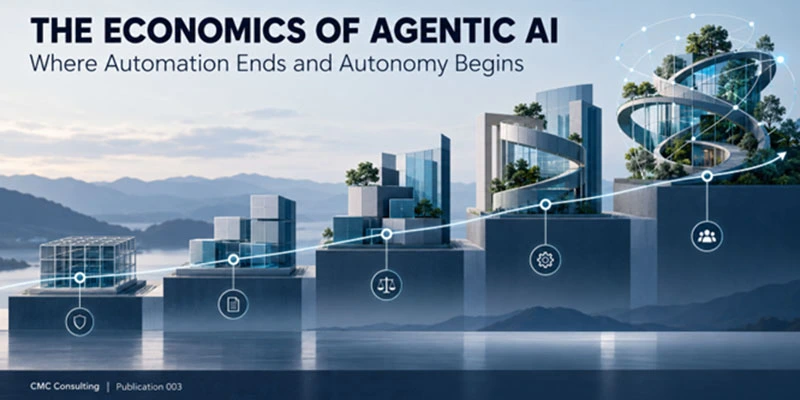
Where Automation Ends and Autonomy Begins
How leaders can determine the economically justified level of autonomy for each business workflow
EXECUTIVE SUMMARY
The central executive question is no longer whether artificial intelligence can automate work. It is how much authority an AI system should receive, in which workflows, under what controls, and at what economic cost.
That distinction matters because automation and autonomy create different business cases. Automation executes a defined task or rule. Autonomy gives a system discretion to interpret conditions, choose actions, use tools, and adapt its path toward an objective. The second may create more value, but it also introduces more variable cost, operational uncertainty, and accountability requirements.
The practical decision is therefore not simply whether to deploy an AI agent. Leaders need to determine the economically justified level of automation and autonomy for each workflow.
Why the economics have changed
Traditional automation usually has a relatively stable unit of work. A rule executes, an application calls a service, or a workflow follows a predetermined route. An agentic system may plan, retrieve information, call several tools, revise its approach, escalate an exception, and retry. The same business request can therefore consume different amounts of computation and operational support.
Model usage is only one part of the cost. Integration, orchestration, security controls, testing, monitoring, exception handling, human review, and process redesign also shape the total cost of agentic execution. Autonomy can create economic value through faster decisions, better service, increased capacity, lower error rates, and opportunities that a fixed workflow would miss. It can also amplify poor decisions or create expensive complexity when applied to the wrong work.
This means that cost per token, cost per license, or hours saved cannot determine the business case on their own. The relevant unit is the cost and value of a completed business outcome at an acceptable level of risk.
Automation and autonomy answer different questions
Dimension | Automation | Autonomy |
Primary question | Should this work be executed automatically | How much discretion should the system have |
Typical logic | Predetermined rules and paths | Goal-directed planning and adaptive action |
Value sources | Volume, speed, consistency and labor substitution | Decision quality, responsiveness, capacity and opportunity capture |
Cost behavior | More predictable by transaction | More variable by task, path, tool use and retry |
Control focus | Process accuracy and exception routing | Boundaries, permissions, monitoring and accountability |
Automation and autonomy belong in one decision model because a workflow may move through several levels as the economics and controls improve.
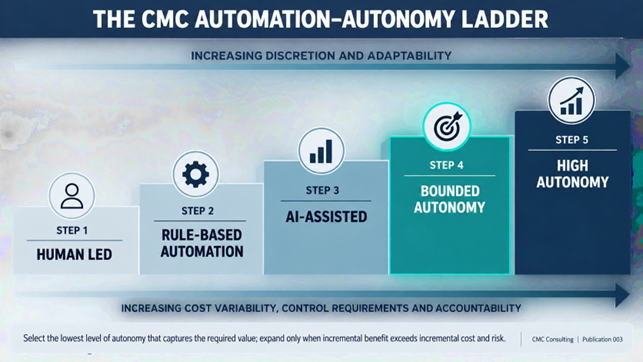
The CMC Automation Autonomy Ladder
CMC proposes five levels for evaluating how work should be performed. The objective is not to push every workflow toward the highest level. It is to select the lowest level that captures the required business value, then increase autonomy only when the incremental benefit exceeds the incremental cost and risk.
Level | Operating mode | Role of technology | Economic condition |
1 | Human led | People perform and decide; technology records or informs | Use when judgment, accountability, rarity, or consequence outweigh automation benefits |
2 | Rule based automation | Software executes stable rules and predefined paths | Use when volume and repeatability support predictable savings |
3 | AI assisted | AI recommends, drafts, predicts, or prioritizes; people approve | Use when better information improves decisions but human control remains valuable |
4 | Bounded autonomy | Agents act within defined permissions, thresholds, and escalation rules | Use when adaptive execution creates value and exceptions remain observable and reversible |
5 | High autonomy | Agents coordinate tasks and tools with limited intervention | Use only when value is high, controls are mature, performance is measurable, and failure is tolerable or recoverable |
The ladder also prevents a common design error: using an agent where deterministic automation would deliver the same outcome more cheaply and predictably. Conversely, forcing a variable, judgment-heavy workflow into rigid automation can create brittle processes and excessive exception handling.
The business case for autonomy
A credible business case should compare adjacent levels on the ladder. The question is whether moving from the current operating mode to the next level improves the economics of the workflow after all costs and risks are included.
CMC frames net value from greater autonomy as:
Incremental business value minus total autonomy cost minus expected failure and control cost
Incremental business value may include greater throughput, shorter cycle time, improved decision quality, higher service levels, reduced leakage, increased revenue, or newly addressable work. Total autonomy cost includes models, tools, integrations, orchestration, data access, evaluations, monitoring, security, human oversight, change management, and exception handling. Expected failure and control cost reflects the probability and consequence of errors, unauthorized actions, rework, compliance breaches, and service disruption.
The comparison should use business outcomes rather than technical activity. A lower cost per model call means little if the workflow requires more retries, generates more exceptions, or shifts work to expensive human review. An agent may cost more than a conventional automation and still create superior economics if it resolves more cases, makes better decisions, or captures value that the fixed process cannot reach.
Seven tests before increasing autonomy
- Value at stake Is the economic value of the completed outcome large enough to justify adaptive execution and its operating cost?
- Workflow variability Does the work contain enough changing context or unstructured input to benefit from planning rather than fixed rules?
- Decision complexity Does the task require interpretation, trade-offs, or sequencing across several systems?
- Error reversibility Can an incorrect action be detected, contained, and reversed before material damage occurs?
- Observability Can leaders measure task success, cost, latency, exceptions, and business outcomes at the level where the agent operates?
- Control readiness Are permissions, thresholds, escalation routes, audit trails, and accountable owners defined?
- Process and data readiness Is the underlying workflow sufficiently stable, documented, integrated, and supplied with trusted data?
A workflow that scores poorly on reversibility, observability, or control readiness may still benefit from AI assistance. It should remain at Level 3 until the organization can govern bounded action reliably.
Governance must rise with autonomy
Governance should be proportional to the authority granted to the system. An assistant that summarizes documents requires a different control model from an agent that changes a production schedule, releases a payment, modifies a customer record, or communicates a binding decision.
For each agentic workflow, leaders should define:
- the business owner accountable for the outcome
- the decisions and actions the agent may perform
- the systems, data, tools, and spending limits it may access
- the conditions that require human approval or escalation
- the evidence retained for monitoring and audit
- the performance, cost, risk, and business-value measures reviewed over time
Higher autonomy also changes operating-model responsibilities. Business leaders own the workflow and value case. Technology and data teams provide architecture, integration, and reliability. Risk, legal, cybersecurity, and compliance functions define constraints. Operations teams manage exceptions and continuous improvement. Finance validates whether the realized economics match the approved business case.
A disciplined path to deployment
Enterprises do not need to decide immediately between manual work and full autonomy. They can build evidence by moving through the ladder.
- Define the outcome Specify the business result, service level, risk tolerance, and accountable owner.
- Establish the baseline Measure current cost, cycle time, quality, capacity, exceptions, and value leakage.
- Select the initial level Choose the simplest operating mode capable of addressing the workflow.
- Test with representative work Evaluate performance across normal cases, edge cases, failures, and escalation paths.
- Measure total economics Track outcome value, model and tool cost, human oversight, exceptions, rework, and operating support.
- Expand autonomy conditionally Increase permissions only when evidence shows that the next level improves value within approved risk limits.
The executive decision
Agentic AI expands the design space between human work and conventional automation. That creates opportunity, but it also removes the comfort of a simple technology business case. Leaders must decide where discretion creates value, where deterministic execution remains superior, and where human accountability must stay directly in the loop.
The strongest agentic portfolio will not be the one with the most autonomous systems. It will be the one that assigns each workflow the level of autonomy that produces the best risk-adjusted business outcome.
Executive diagnostic question Where should your organization draw the line between AI-assisted automation and autonomous execution?
CMC Consulting helps leadership teams assess AI opportunities, design the appropriate operating model, build the business case, and translate AI ambition into an executable transformation roadmap with measurable outcomes.
Discuss your AI transformation agenda with CMC Consulting
Selected references
- McKinsey and Company Is that AI agent worth it? Agentic economics and the modern operating model
- World Economic Forum The AI-First Operating System: A Blueprint for Operating and Business Model Innovation
- National Institute of Standards and Technology AI Risk Management Framework
- National Institute of Standards and Technology AI Agent Standards Initiative
- Anthropic How we built our multi-agent research system
About the Author
- Carlos Matias
- Founder & CEO, CMC Consulting
Looking for something?
Sign up and receive exclusive content.
Categories
Entry and Business Expansion in Brazil
Business Management
Process Management
Interim Management
Follow us on social media
Recent articles
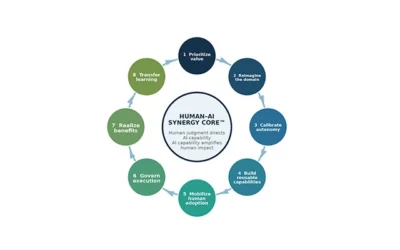
Move Beyond Isolated AI Pilots: Start Transforming Business Domains
How the CMC Domain Transformation Flywheel Turns Human Judgment and AI Capability into Cumulative Business Value The unit of AI transformation should not be the isolated use case. It should be the business domain: an end-to-end system integrating...

Before You Decide What to Transform, Ask a Different Question
Organizations rarely suffer from a shortage of transformation initiatives. But each can lead leadership teams to begin the conversation one question too late. WHAT MUST THE ORGANIZATION BECOME CAPABLE OF DOING DIFFERENTLY AFTERWARD? Estimated reading time:...
© 2024 CMC Consulting. All rights reserved.
Related Articles
Move Beyond Isolated AI Pilots: Start Transforming Business Domains
How the CMC Domain Transformation Flywheel Turns Human Judgment and AI Capability into Cumulative Business Value The unit of AI transformation should not be the isolated use case. It should be the business domain: an end-to-end system integrating...
Before You Decide What to Transform, Ask a Different Question
Organizations rarely suffer from a shortage of transformation initiatives. But each can lead leadership teams to begin the conversation one question too late. WHAT MUST THE ORGANIZATION BECOME CAPABLE OF DOING DIFFERENTLY AFTERWARD? Estimated reading time:...

The CIO at an Inflection Point
From Technology Ownership to Enterprise Orchestration A Framework for CIOs, CEOs and Enterprise Transformation LeadersBy: Carlos Matias - CEO CMC ConsultingEstimated reading time: 8 minutes The CIO Mandate Is Being Rewritten For decades, the CIO mandate...
