

Before You Decide What to Transform, Ask a Different Question

Organizations rarely suffer from a shortage of transformation initiatives. But each can lead leadership teams to begin the conversation one question too late.
WHAT MUST THE ORGANIZATION BECOME CAPABLE OF DOING DIFFERENTLY AFTERWARD?
Estimated reading time: 8 minutes
Before You Decide What to Transform, Ask a Different Question
Transformation should begin with the business outcome and the organizational capability required to achieve it—not with the technology or initiative.
By Carlos Matias, Founder & CEO, CMC Consulting
September 4, 2026 | 8-minute read
Organizations rarely suffer from a shortage of transformation initiatives.
- “We need an AI transformation.”
- “We need to replace the ERP.”
- “We need to redesign the operating model.”
- “We need to automate this process.”
- “We need to become more digital.”
Any of those may be right.
But each can lead leadership teams to begin the conversation one question too late.
Before asking:
What should we transform?
There is a more fundamental question:
What must the organization become capable of doing differently afterward?
That distinction may sound subtle.
It isn’t.
Transformation creates business value when it enables an organization to perform differently—not merely when a new technology, process or operating model has been successfully implemented.
1. The Missing Bridge Between Business Outcomes and Transformation
Consider a company trying to improve working capital without compromising customer service.
The desired business outcome is clear.
A leadership team might quickly conclude:
“We need AI-enabled demand planning.”
Perhaps it does.
But technology is already entering the conversation before the required organizational capability has been defined.
A better question would be:
What must this organization become capable of doing differently to release working capital while protecting service?
The answers could include the ability to:
- detect changes in demand earlier;
- model demand and supply scenarios faster;
- dynamically segment inventory;
- identify excess and obsolete exposure sooner;
- make cross-functional trade-offs using shared economic signals; and
- adjust replenishment decisions continuously rather than waiting for the next planning cycle.
Now the transformation conversation changes.
Instead of beginning with a technology and searching for where to apply it, leadership can examine what prevents those capabilities from existing today.
Is the constraint the planning process?
Fragmented decision rights?
- Skills?
- Incentives?
- Governance?
- Poor data?
- Legacy technology?
Or, as is often the case, some combination of them?
Only then can leaders determine what actually needs to transform.
2. Capability Should Connect Strategy to Transformation
This suggests a different transformation sequence:
BUSINESS OUTCOME → REQUIRED CAPABILITY → CAPABILITY GAP → TRANSFORMATION ARCHITECTURE → BUSINESS VALUE
The business outcome defines what must improve.
The required capability defines what the organization must be able to do differently.
The capability gap reveals what prevents it from doing so today.
And that gap—not the attractiveness of a particular technology—should determine the transformation architecture.
That architecture may involve changes across:
- operating model;
- processes and workflows;
- organization and skills;
- decision rights and governance;
- data;
- performance management; and
- technology.
AI may be central to the solution.
But:
AI is an enabler of capability. It is not the capability itself.
That distinction is fundamental.
CMC Capability-Led Transformation Framework
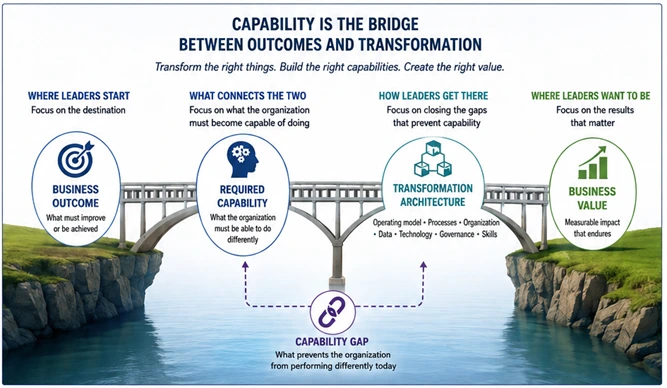
Capability is the bridge between outcomes and transformation: define the business outcome, identify the required organizational capability, diagnose the capability gap, design the transformation architecture, and measure the resulting business value.
3. The Dangerous False Positive of Transformation
Many transformation scorecards are very good at measuring implementation:
- Was the system deployed?
- Was the program delivered on time?
- Was the budget achieved?
- Were employees trained?
- Were the milestones completed?
Those are necessary questions.
But they measure delivery.
They do not necessarily measure transformation.
A new ERP can go live successfully while the organization retains the same planning problems.
An AI application can reach production while employees continue making decisions through the same slow approval structures.
A process can be automated while preserving unnecessary complexity.
An operating model can be redesigned on paper while decision behavior remains unchanged.
Therefore:
A transformation can be operationally successful and strategically unsuccessful at the same time.
This is why transformation success should be evaluated at three levels:
LEVEL 1 — DELIVERY
Did we implement the initiative?
LEVEL 2 — CAPABILITY
Can the organization now reliably perform differently?
LEVEL 3 — VALUE
Did performing differently improve the intended business outcome?
Too many transformation dashboards stop at Level 1.
The danger is obvious: management can receive a green transformation report while the business problem that justified the transformation remains stubbornly red.
4. But Don’t Eliminate Experimentation
There is an important qualification.
Leaders cannot always know precisely which future capabilities will matter before experimentation begins—particularly with rapidly evolving technologies such as generative and agentic AI.
Technology can reveal possibilities the organization had not previously imagined.
So the answer is not to design every capability perfectly before taking action.
Instead, treat the required capability initially as a hypothesis:
OUTCOME → CAPABILITY HYPOTHESIS → EXPERIMENT → LEARN → REFINE → TRANSFORM → SCALE → MEASURE
Experimentation helps us discover what is possible.
But experimentation should help discover the transformation strategy.
It should not become the transformation strategy by accident.
A hundred AI pilots do not necessarily constitute an AI transformation. They may simply constitute a hundred AI pilots.
The leadership challenge is determining which experiments reveal capabilities worth building at enterprise scale—and which do not.
5. From Transformation Projects to Capability Creation
This changes the executive conversation.
Instead of asking... | Ask... |
Where should we deploy AI? | What valuable capability could AI help us create? |
Which process should we automate? | What must this process become capable of delivering that it cannot deliver reliably today? |
What should the new operating model look like? | What decisions and behaviors must the new operating model enable? |
And instead of celebrating transformation because the project has been completed, ask:
Can our organization now do something materially better than it could before?
Ultimately, the real unit of transformation may not be the project.
It may be the organizational capability required to produce a business outcome.
6. The Executive Question Before the Next Transformation
Before approving the next major transformation initiative, put this question on the table:
What must our organization become capable of doing differently afterward?
Then ask:
What prevents us from doing it today?
And only then:
What should we transform?
Because transformation completion is not capability creation.
And capability creation is not complete until it produces business value.
From Insight to Action
For leadership teams, this creates a practical test before committing substantial resources to AI, ERP, automation, operating-model redesign or broader business transformation:
- What measurable business outcome are we trying to change?
- What must the organization become capable of doing differently to produce that outcome?
- What prevents that capability from existing reliably today?
- What combination of operating model, process, people, governance, data and technology changes will close that gap?
- How will we measure delivery, capability creation and business value separately?
That turns transformation from an initiative-first conversation into an outcome-and-capability-led management discipline.
About CMC Consulting
CMC Consulting advises organizations at the intersection of AI & Business Transformation, operating models, end-to-end supply chain and operations, and international market entry and expansion.
Our perspective is straightforward:
ADVISE. TRANSFORM. DELIVER VALUE.
If your organization is evaluating an AI, digital, operating-model or business transformation initiative, CMC can help leadership teams connect the intended business outcome to the capabilities, transformation architecture and execution required to deliver measurable value.
Carlos Matias | CEO, CMC Consulting
- This publication represents the author’s own perspectives and analysis.
- Executive framework and visuals: CMC Consulting Analysis
Looking for something?
Sign up and receive exclusive content.
Categories
Entry and Business Expansion in Brazil
Business Management
Process Management
Interim Management
Follow us on social media
Recent articles
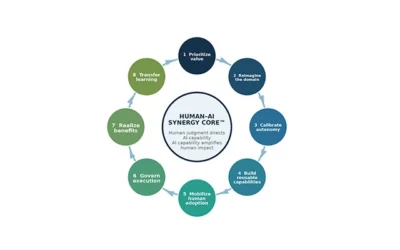
Move Beyond Isolated AI Pilots: Start Transforming Business Domains
How the CMC Domain Transformation Flywheel Turns Human Judgment and AI Capability into Cumulative Business Value The unit of AI transformation should not be the isolated use case. It should be the business domain: an end-to-end system integrating...
The Economics of Agentic AI Where Automation Ends and Autonomy Begins
Where Automation Ends and Autonomy Begins How leaders can determine the economically justified level of autonomy for each business workflow EXECUTIVE SUMMARY The central executive question is no longer whether artificial intelligence can automate work. It...
© 2024 CMC Consulting. All rights reserved.
Related Articles
Move Beyond Isolated AI Pilots: Start Transforming Business Domains
How the CMC Domain Transformation Flywheel Turns Human Judgment and AI Capability into Cumulative Business Value The unit of AI transformation should not be the isolated use case. It should be the business domain: an end-to-end system integrating...
The Economics of Agentic AI Where Automation Ends and Autonomy Begins
Where Automation Ends and Autonomy Begins How leaders can determine the economically justified level of autonomy for each business workflow EXECUTIVE SUMMARY The central executive question is no longer whether artificial intelligence can automate work. It...

The CIO at an Inflection Point
From Technology Ownership to Enterprise Orchestration A Framework for CIOs, CEOs and Enterprise Transformation LeadersBy: Carlos Matias - CEO CMC ConsultingEstimated reading time: 8 minutes The CIO Mandate Is Being Rewritten For decades, the CIO mandate...
